Showing posts with label Human Rights. Show all posts

Friday, 7 December 2018

The 4th ITUC World Congress concluded in Copenhagen 7th December - " Change the Rules "


More than 1,200 participants took part in five days of debate to shape the policies and priorities for the international trade union movement for the next four years. The Congress was addressed by Prime Minister of Denmark Lars Løkke Rasmussen, the Lord Mayor of Copenhagen Frank Jensen and International Labour Organization Director-General Guy Ryder.

ITUC President João Felicio read a letter from former President of Brazil, Lula de Silva, thanking the trade union movement for the solidarity and collective action to protest against his unjust imprisonment.

Refugees and migrants were recognised by Congress with the message that refugees are welcome in our workplaces and our communities. Trade unions are committed to campaign for peace and provide not only the right to decent work, but also the right to safe haven and access to public services including health and education.

Two candidates, Susanna Camusso and Sharan Burrow, were nominated for the position of General Secretary and Burrow was elected by a close margin.

Five urgent resolutions were passed calling for:
-          Human rights and peace in Colombia;
-          Solidarity with workers and students in Iran;
-          Labour law reforms in Hungary;
-          Labour rights and solidarity with independent trade unions in Kazakhstan;
-          Freedom for Lula.

“We leave the Congress united to build worker’s power to change the rules.  The international union movement stands for peace, democracy and rights for working people. We must defeat and transform the failed economic model of today.  We must defend workers’ and other human rights and demand a new social contract. As the world shifts, with technological and climate change and as people move, because of desperation or from choice, we must have a Just Transition. And equality for all people is at the centre of our mandate,” said Sharan Burrow.

At the conclusion of the World Congress, unions committed to:

  • Organise, to create a 250 million member ITUC over the next four years, to build workers’ power;
  • A new social contract, where businesses including platform businesses are made to take responsibility for their workers, and a UN Business and Human Rights Treaty;
  • A Just Transition to sustainable economies to tackle climate change and keep temperature rises to 1.5 degrees or less;
  • Reverse the trend of low wage growth and rising inequality through collective bargaining, increased minimum wages and social protection; and,

·         Close the gender pay gap, fight discrimination and racism and take forward action against gender based violence.
These are foundations for the future of work.

“Companies like Amazon, whose business model is based on extracting public subsidies, paying little or no taxes, mistreating or dehumanising workers, were sent a clear message. If you do not change the way you operate, if you don’t respect the rights of workers, we will change you. We will change the rules and break up Amazon,” said Burrow.

The statement adopted by the ITUC World Congress included four pillars – on peace democracy and rights, regulating economic power, global shifts - just transitions and equality, which set out the ITUC agenda for the next four years.

Women delegates attending the ITUC World Congress increased from 42 percent in 2014 to 46 percent in 2018.

The ITUC General Council elected Ayuba Wabba, President of the Nigerian Labour Congress, as ITUC President.

Cathy Feingold of AFL-CIO (USA) and Karl-Petter Thorwaldsson of LO Sweden were elected as the ITUC Deputy Presidents.

Owen Tudor, Victor Baez and Mamadou Diallo were elected as the ITUC Deputy General Secretaries.

The next ITUC World Congress will be held in 2022.

The official video record of the plenary sessions and leaders’ speeches will be available at: https://congress2018.ituc-csi.org/multimedia

For more information, contact Gemma Swart at +32 479 06 41 63 gemma.swart@ituc-csi.org (English) or Theo Morrissey at +32 499 14 56 95 theo.morrissey@ituc-csi.org (English, French, Spanish).

The ITUC represents 207 million workers in 163 countries and territories from 331 national trade unions.

Follow us on the web: www.ituc-csi.org and www.youtube.com/ITUCCSI

Media item from ITUC 

Monday, 3 December 2018

International Trade Union Confederation (ITUC) ....includes live streaming !!! PSI is one of the GUFS that make up the ITUC


Copenhagen, 2 December 2018 (ITUC OnLine): Workers across the globe are struggling to make ends meet, believe their jobs are insecure and don’t believe their voices matter in politics according to a new global public opinion poll from the International Trade Union Confederation (ITUC).

Sharan Burrow, General Secretary of the ITUC, said: “Governments are failing to respect workers, and they are failing to respect voters. The fragility of the global economy is on show when 59% of people in work are only just managing, struggling to make ends meet or not managing at all and nearly two in three don’t generally feel that their voice matters in politics. Without action to raise wages and change the rules for working people, we put democracy at risk.”

Released at the opening of the 4th ITUC World Congress in Copenhagen, Sunday 2 December, the ITUC Frontline Poll 2018, commissioned from polling company YouGov, covers the general public of fourteen countries.

The poll showed:
·        59% of people in work are just about managing financially, struggling to make ends meet, or are not managing at all financially, often going without essentials or falling into debt.
·        Nearly one in four (23%) people in work believe their job is insecure.
·        Only 37% of people think their voice always or mostly matters in politics.

“Shared prosperity is elusive, people are struggling to get by on the wages they earn, and one in four people feel their job is insecure. Social cohesion is at risk as the global economic model based on corporate greed fails working people,” said Sharan Burrow.

The ITUC represents the largest global democratic community, and the World Congress will debate the mandate for the global trade union movement, with more than 1,200 trade unionists from 132 countries.
“In order to rebuild peace, democracy and rights, we must regulate economic power – with minimum living wages, social protection and a new social contract. Workers need the security of just transitions, along with the guarantee of equality that ensures inclusion, to deal with the shifts in the world of work due to climate, technology and the displacement of people.

“First it was too big to fail banks, bailed out during the global financial crisis. Today it’s too big to touch companies like Amazon which are exploiting workers, avoiding tax, flouting competition policy and distorting the model of business with their monopoly power.

“When governments fail to stand up for their own people, regulate corporate power, ensure fair taxation, distribution of wealth through minimum wages, collective bargaining rights and social protection and vital public services, you get a world where nearly two out of three people don’t feel their voices matter in politics.

“Only when governments stand up for their own people, regulate corporate power, ensure fair taxation, distribution of wealth through minimum wages, collective bargaining rights and social protection, and ensure vital public services, will the huge and growing political confidence gap disappear.

“The global labour movement, meeting in Copenhagen at the ITUC World Congress, is putting governments and business on notice. Multilateralism is in crisis and democracy is at risk. We need to change the rules of the global economy to rebuild trust,” said Ms Burrow.

The poll was conducted 15 October – 6 November in Brazil, Bulgaria, Denmark, India, Indonesia, Mexico, Morocco, Portugal, the Philippines, South Africa, South Korea, Turkey, the United Kingdom and the United States.


Notes for editors:
For a copy of the YouGov data tables, Wages, Job Security, Trust in Politics and Democracy (English), contact Gemma Swart at gemma.swart@ituc-csi.org.

The ITUC Frontline Poll 2018 covers the adult populations of Brazil, Bulgaria, Denmark, India, Indonesia, Mexico, Morocco, Portugal, the Philippines, South Africa, South Korea, Turkey, the United Kingdom and the United States. All polling numbers quoted above represent the average of the 14 countries, with each country given an equal weight.

In each country at least 1,000 respondents were interviewed, yielding a total of 14,834 respondents. All interviews were conducted online. YouGov carried out the fieldwork 15 October – 6 November 2018. The figures have been weighted on a national level and are representative of all adults in each respective country.

The ITUC World Congress opens in Copenhagen on Sunday 2 December and concludes on Friday 7 December 2018. The ITUC represents 207 million workers in 163 countries and territories from 331 national trade unions.

Congress Daily Highlights Live-streamed (All times Copenhagen +1 GMT)

Sunday 2 December 16:00 – 18:00 Opening Ceremony
Includes addresses from Prime Minister of Denmark Lars Løkke Rasmussen, the Lord Mayor of Copenhagen Frank Jensen, International Labour Organization Director-General Guy Ryder, LO-Denmark President Lizette Risgaard and ITUC President João Antonio Felicio.

Monday 3 December 9:00 – 12:30 Plenary
ITUC General Secretary Sharan Burrow’s address outlining the state of the world for working people and the findings of the ITUC Frontline Poll 2018.

Sunday, 25 November 2018

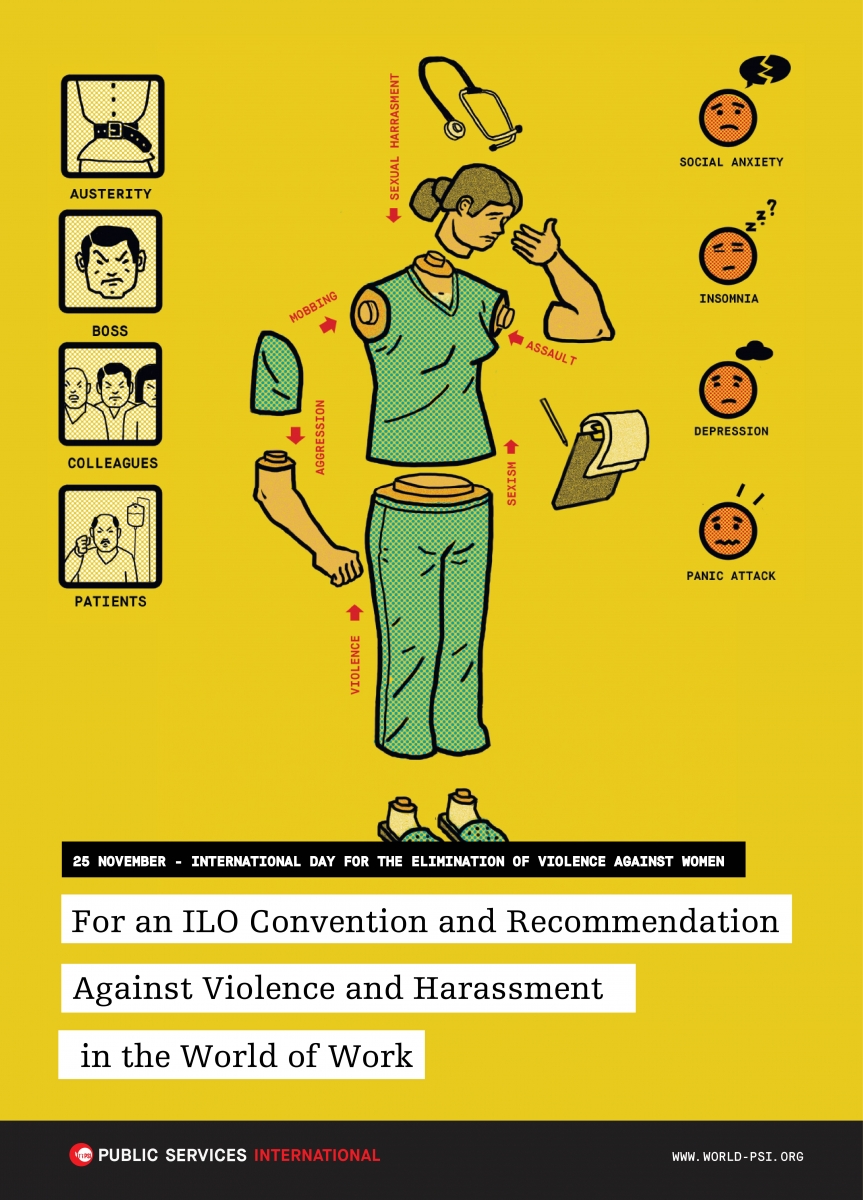
25 November - International Day for the Elimination of Violence against Women.

Ending workplace violence and harassment in public services

The recent deaths of two young women health workers in Nigeria, Saifura and Hauwa, are the latest tragic examples of the dangers faced by workers when delivering public services. However, on this 25 November, the International Day for the Elimination of Violence against Women, we must remember that it is not only in the extreme conditions of conflict zones that workplace violence occurs.

A few months ago, two young women health workers were executed by a Boko Haram faction in Nigeria. Saifura Hussaini Ahmed Khorsa, 25, and Hauwa Mohammed Liman, 24, were both midwives with the International Committee of the Red Cross (ICRC) in the state of Borno and were abducted in March along with the UNICEF nurse Alice Loksha, who is still alive.
At the time of their abduction, all three were providing essential prenatal care to communities in Rann, a small town whose population has more than doubled since it became the location for a camp of around 45,000 internally displaced people. Saifura, as her father said, “was serving humanity”.
The deaths of Saifura and Hauwa were the latest and tragic examples of the dangers faced by workers when delivering public services. However, it is not only in the extreme conditions of conflict zones that workplace violence occurs, although the health sector, which has a predominantly female workforce, is particularly affected.
So much so that the World Health Organization (WHO) calculates that violence in this sector accounts for 25% of all incidents at the workplace.
“Violence is not only perpetrated by those who are directly involved in labour relations, such as managers and colleagues, but also by patients, family members and visitors”, says Irene Khumalo, the new Chair of the PSI’s World Women’s Committee and member of the Swaziland Democratic Nurses’ Union.
Khumalo notes that wars, internal conflicts and economic crises make the situation worse.

ILO Convention

It is in this context and on the International Day for the Elimination of Violence Against Women that PSI reiterates its commitment to the discussion and adoption of a Convention and Recommendation to End Violence and Harassment in the World of Work by the International Labour Organization (ILO) in 2019.
We believe that this convention should be seen as the outcome of the long struggle by women in the international trade union movement for an instrument that addresses gender-based violence as a multi-sectorial and systemic issue in the world of work.
Women began this journey a long time before 2015, when the ILO’s Governing Body decided to put discussion of the instrument on the agenda of the International Labour Conference (ILC) in 2018. The initial focus was gender-based violence, but the ILO broadened the scope, form and content of the discussion to include the world of work as a whole in order to address the many manifestations of violence.

Tax Justice

PSI argues that sufficient resources must be allocated to basic services like health care if they are to have the material foundations necessary to function without the threat of violence against either workers or service users. It also calls for the formulation of public policies able to provide gender-responsive public services. 
In this context, PSI General Secretary Rosa Pavanelli emphasises that:
“PSI is part of the global movement for Tax Justice that advocates for States to recover resources stolen through tax avoidance and evasion and that are needed for investment in quality public services.”

Marginalised groups

Clare Middlemas, youth representative on PSI’s World Executive Board and a member of the SPSF union in Australia, says it is also essential
“to continue with the work of fully including young workers, migrants, indigenous and African peoples and LGBTI workers, in the list of groups recognised as being especially vulnerable to violence and harassment at work.”

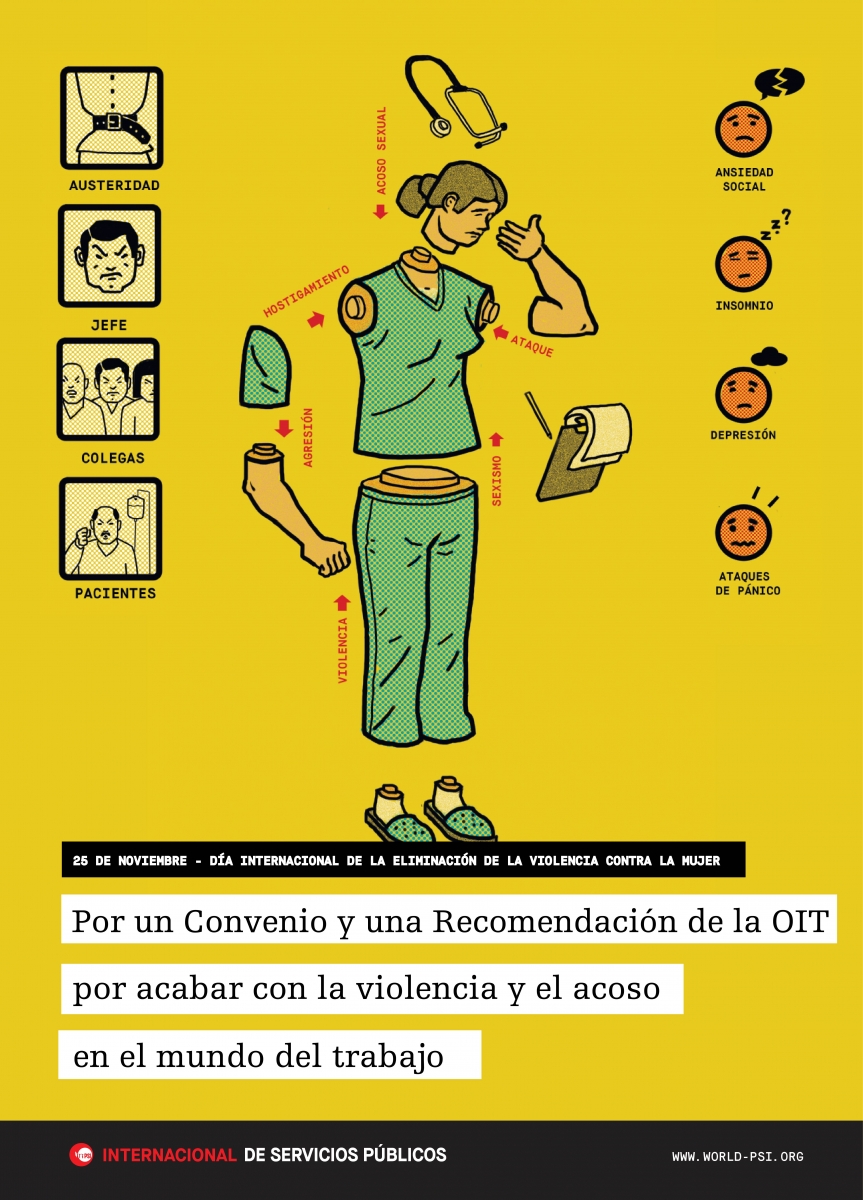
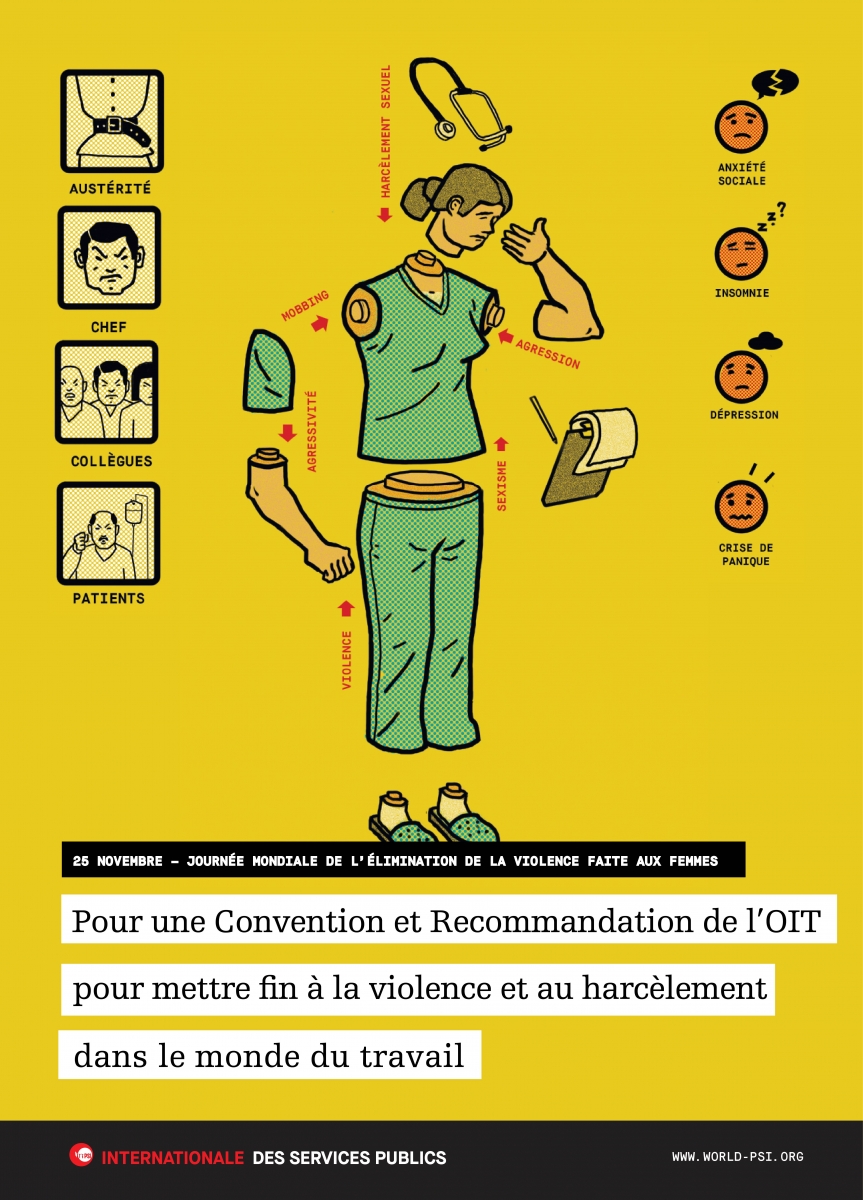
Download our posters


For more information, see:

Tuesday, 6 November 2018

PSI Affiliate - Pakistan WAPDA Electricity Union argues for more safety inspection of equipment , amendment of outdated Pakistan Labour laws, increased wages and pensions


The above article has been supplied by WAPDA and was originality published in the ' DAWN ' newspaper in Lahor , Pakistan on the 4th November . Supplied by Osama  Tariq Secretary All Pakistan Workers  Confederation  (Regd) - Bukhtiar  Labour  Hall  28 Nisbet  Road  Lahore  Pakistan. pwf@brain.net.pk  

Monday, 22 October 2018

Latest up date from Transparency International -


Transparency International logoFor the past few weeks we’ve been hard at work preparing for the International Anti-Corruption Conference (IACC) taking place next week 22-24 October in Copenhagen, Denmark. The conference takes place in the Bella Center and is organised by us, the Danish Ministry of Foreign Affairs, and the IACC Council.

This year’s theme is Together for Development, Peace and Security: Now is the Time to Act. Our objective is to move the fight against corruption from words to action. In today’s increasingly polarised world where democracy is being weakened in too many countries, we need to work together to take concrete steps towards sustainable development, peace and security.

Next week also kicks off our 25th anniversary year, and we want to celebrate that with real change. So we’re excited to bring together leading experts, innovators and activists from civil society, government, business and academia in more than 50 workshops and six high-level plenaries.

During the conference we are excited to announce the winners of the Anti-Corruption Award, host the Fair Play Concert with headliner yasiin bey (formerly Mos Def), as well as the film festival Films 4 Transparency (F4T).

For those of you who can’t make it but want to keep up with all the action, we invite you to sign up to the IACC newsletter to get the latest updates and highlights from the conference and events.
You can also join or follow the conversation on Twitter and Facebook with the official hashtag #18IACC.
We look forward to welcoming participants in Copenhagen very soon!

News from Transparency International

banner2

Everything you need to know about the 18th International Anti-Corruption Conference (#18IACC)

The 18th International Anti-Corruption Conference (IACC) will take place from 22-24 October in Copenhagen, Denmark under the theme Together for Development, Peace and Security: Now is the Time to Act.

New on Voices for Transparency

banner2

Time for China to step up to global anti-corruption responsibilities

While Chinese exports have recently been in the spotlight due to the US-China trade war, we have been looking at them for a different reason: the world's largest exporter is failing to enforce its own laws on foreign bribery.
banner2

Building a peaceful and safer world through collective action in the fight against corruption

In this joint blog post with the Danish Government, OECD, & Open Government Partnership (OGP), we explore how despite advances at the international level, progress to fight corruption has been too slow. It is only through a concerted collaborative effort can hope to effectively combat corruption and promote inclusive, fair and peaceful societies across the world.
banner2

Caribbean golden visas: rum deal for Europe

When you think of the Caribbean what is the first thing that comes to mind? Pristine island shores, magnificent coral reefs, secret white-sand beaches? If you are looking for a second (or third) passport, you might be more interested in visa-free Schengen travel, lax banking regulations, or low business taxes.
banner2

How can the G20 live up to their anti-corruption promises?

Anti-corruption is crucial for strong, sustainable and balanced growth, one of the G20’s main objectives. Yet, too often corruption remains an afterthought in G20 leaders’ decisions and actions. 


Corruption in the news this week

Top Stories


USA/Saudi Arabia: Trump denies personal financial ties with Saudi Arabia
Politico (16 October)  


Help put an end to corruption. Support our work.

Forward this message to a friend, or follow us on social media to keep up to date!
Join us on Facebook

Join us on Twitter

See us on Instagram

Connect on LinkedIn


Friday, 12 October 2018

World Bank’s World Development Report 2019: Unsatisfactory policy perspective on changes in the world of work


Brussels, 12 October 2019 (ITUC OnLine): Responding to the World Bank’s publication of the “World Development Report 2019: The Changing Nature of Work” on Friday, ITUC General Secretary Sharan Burrow expressed disappointment in the Bank’s ‘flagship’ report:  “The WDR 2019 seems more intent on delivering a few highly questionable and simplistic policy messages about the need to deregulate business and alleviate it of obligations to contribute to workers’ social protection than providing a thoughtful perspective on challenges created by rapid transformations in the world of work.”

She added: “It is strange that the World Bank would publish the WDR 2019 as its flagship development research report when most of its central assertions are not backed up by serious analysis or are even contradicted by data presented in the report.” 

Burrow gave as an example the WDR 2019’s repeated claim that wide-scale deregulation of business will reduce informality, even though the report contains information showing that “informality has remained remarkably stable” despite a rapid fall of business regulation in the past two decades. “Support for further deregulation will only reinforce strategies of platform companies to subvert employment relationship rules, increase precarious work, pay poverty wages and undermine workers’ rights”, said Burrow.

Although the WDR contains some pertinent analysis of the manner in which digital businesses have accelerated tax base erosion and profit shifting, the need to tighten tax rules on these businesses is completely omitted in the recommendations section.  Instead, the expansion and increase of regressive value added taxes is presented as the “first line of reform for developing countries” to finance basic social assistance.

The WDR even opposes exemptions or lower tax rates for basic necessities that could make VATs less regressive. Employer-financed social protection “is not a good fit for developing countries”, so business would be alleviated of any obligation to contribute.

“The recommendations to shift taxation from companies to consumers and to slash business regulation is reminiscent of the pro-deregulation drum-beating that we have been accustomed to reading in the Bank’s annual ‘Doing Business’ report for fifteen years. It is astonishing that the World Bank would allow the same right-wing ideology to permeate what is supposed to be its contribution to the debate on the future of work,” Burrow said.

Burrow contrasted the WDR 2019, which frequently presents selective evidence and makes unwarranted generalisations on the basis of outlier examples, with the important contributions made by the Bank’s “WDR 2013: Jobs”.  The earlier WDR included an exhaustive review of economic research on the impact of labour regulations and concluded that long-held myths about such regulations being job-destroyers were not based in reality: “the impacts on employment levels tend to be insignificant or modest”.

Burrow also contrasted the anti-worker perspective of the WDR 2019 with the major step taken by the World Bank on 1 October when its new labour safeguard – which stipulates respect for workers’ rights in all Bank-financed projects – entered into effect as part of the Bank’s new Environmental and Social Framework.

Burrow concluded: “In a world in which inequality has been increasing for more than three decades and workers’ rights are constantly under threat, it is frustrating to see the Bank finally recognise the importance of labour rights in its new safeguards policy and then undercut that less than two weeks later by promoting an unabashedly pro-business agenda in the WDR 2019.”  

Media advice from ITUC 

Thursday, 11 October 2018

Governments Should Back Binding UN Treaty on Business and Human Rights


Governments Should Back Binding UN Treaty on Business and Human Rights

Brussels, 11 October 2018 (ITUC OnLine): The ITUC is calling on governments to support a United Nations Binding Treaty on Business and Human Rights in negotiations underway at the UN Human Rights Council. A “Zero Draft” of the Treaty will be the basis for a further round of talks starting on 15 October in Geneva. 
 
Sharan Burrow, ITUC General Secretary, said: “The world is crying out for multinational corporations to be held responsible for their international operations, to end the abuse and violations of workers’ and other human rights in global supply chains. Today, companies can flout international law at will outside their home bases, and workers are paying a heavy price with poverty wages, oppressive working conditions, unacceptably long working hours and death, injury and sickness caused by work. This treaty should close a massive loophole which allows corporations to flout international labour and human rights standards.”
The zero draft includes crucial provisions which would represent a big step forward in ensuring corporate accountability throughout global supply chains - 

  • a requirement for businesses to adopt and apply human rights due diligence policies and procedures;
  • a strong focus on access to effective judicial recourse for victims of human rights violations;
  • a basis for “parent-based extraterritorial jurisdiction”, which will allow workers to have access to justice in the home countries of multinational companies; and
  • mutual legal assistance and international cooperation between states in transnational cases.

The ITUC is calling for improvements to the draft, including:

  • a re-statement of the duty of businesses to respect human rights throughout their operations;
  • explicit recognition that human rights standards have primacy over trade and investment agreements;
  • alignment of due diligence provisions with the existing UN Guiding Principles on Business and Human Rights; and 
  • creation of a strong international enforcement mechanism beyond the frameworks which have been proposed so far for the Treaty.

The ITUC is also seeking to remove ambiguous language from the draft, and for the treaty to limit the use of “forum non conveniens”, a legal doctrine which corporations use to have cases against them heard by courts in countries where the law is weak.

“Governments at the G20 and other fora have been making pledges to stop the undermining of ILO standards as a way to get a competitive edge in global markets. It’s time these words are put into action through a binding UN Treaty,” said Burrow.

To read the ITUC/Global Union Federations position paper for the negotiations.

Monday, 8 October 2018

Decent Work’s 10th anniversary – JUST DO IT!


Last Sunday, 7 October 2018, we “celebrated” the 10th anniversary of the World Day for Decent Work (WDDW): 10 years that unions across the world have been fighting to place decent work at the centre of government policies, to bring back economic growth that puts people first – people over profit.

In the past 10 years, decent work has been echoed in major global instruments, such as the Second United Nations Decade for the Eradication of Poverty (2008-2017), the Conference on Sustainable Development (2011) and during the UN General Assembly in September 2015 – decent work and the four pillars of the ILO Decent Work Agenda are central elements of the new 2030 Agenda for Sustainable Development. Goal 8 of the 2030 Agenda calls for the promotion of sustained, inclusive and sustainable economic growth, full and productive employment and decent work for all.

But this decade also witnessed the global financial crisis of 2007-2008, one of the worst ever. World leaders responded with austerity recipes that led to unemployment, informal and precarious jobs, privatisation and deregulation, all of which increased the gap between the richest 1% and the rest of the planet. Decent work took a heavy blow.

Add to this the changes in the world of work brought about by internet technology, where apps drive the gig economy and digitalisation is causing turmoil in work relations, and the decent work agenda is further strained.

The emerging forms of capitalism which were born from the crisis confront us with new working relationships, such as the “Uberization” of work – which certainty is not the future of work we want.  In public services, we are seeing more proposals to privatise, and to financialise and securitise the assets of these services – basically turning them over to the financial sector’s speculations. Public coffers were emptied to prop up the financial institutions that were on the edge of failure, but workers and trade unions are fighting back.
In public services, PSI
·          helps unions understand and act on the connections between public finance and decent work: if the corporations and the world’s richest continue to evade taxes, governments will continue to be starved of funds, public services will be eroded, and working conditions will be the first victim – with our communities not far behind.
·          leads a push against the latest proposals to privatise, financialise and securitise public services, turning our public assets over to the financial institutions whose greed and recklessness caused the global financial crisis.
·          supports the growing wave of ‘remunicipalisations’, whereby privatised services are brought back under public ownership and management.
·          holds the line on attempts to eliminate the right to strike, denying workers the ability to withhold their labour – undermining one of the pillars of labour rights.
·          advocates for the rights of migrants and refugees to access basic public services and decent work.
·          organises young workers who are often the most affected by the lack of decent work opportunities.

In all of these struggles, PSI’s messages are clear: "Unions must be able to fight on many fronts and work with community allies to defend the decent work agenda, which forms the basis for just and equitable workplaces and strengthens families and communities", says Rosa Pavanelli, PSI's General Secretary.

From these rather limited but persistent successes we learned that the access to universal quality and gender responsive public services is essential for a better world.
We celebrate the 10th anniversary of the World Day for Decent Work with that in mind and call for all workers to join with unions to fight for Decent Work for All!
Public Services International (PSI) is a global trade union federation representing 20 million workers who deliver public services in more than 160 countries. PSI champions human rights, advocates for social justice and promotes universal access to quality public services. PSI complies with European Union privacy legislation. Please refer to our privacy policy or contact privacy@world-psi.org, if you want to view, update or delete any of your contact details. Subscribe to our mailing lists: http://www.world-psi.org/subscribe