The above article was published in the ' Nation' , newspaper Pakistan 4th November, supplied by Osama Tariq Secretary, All Pakistan Workers
Confederation (Regd) , Bukhtiar Labour Hall
28 Nisbet Road Lahore Pakistan. pwf@brain.net.pk
Showing posts with label Superannuation - Pensions. Show all posts
Friday, 9 November 2018
Wednesday, 7 November 2018
ILO study reveals bankruptcy of pensions privatisation
A new publication by the ILO confirms PSI’s long-held position: the privatisation of public pension systems has delivered vast returns to a tiny financial elite while diminishing the incomes of workers in retirement.

- The primary beneficiaries of privatisation are elites within societies
- Privatisation frequently facilitates and increases corruption
- Government and corporate promises of universal benefit of privatisation are inflated and under-delivered
- When governments announce privatisation, unions must prepare to fight
- Accumulated evidence shows that most privatisations can and should be defeated
- Privatisations can be reversed[i]
The privatisation of pensions has been a core element of neoliberal restructuring promoted by the World Bank, the IMF, the OECD, the Inter-American, African and Asian Development Banks, USAID and the financial services companies who derive the ultimate benefit. And, as with much of the privatisation story, Chile was the first country to privatise pensions systems under the direction of US-backed military dictator Augusto Pinochet in 1981.
Rosa Pavanelli, PSI General Secretary, notes:
The lessons for trade unions in public services are equally important:
Rosa Pavanelli, PSI General Secretary, notes:
“I want to congratulate Isabel Ortiz, Fabio Durán and their team at the ILO for this book. It starkly reveals the hypocrisy of pension privatisation, which has basically institutionalised the theft of workers’ wages. It shows the moral bankruptcy of the neoliberals, who knew exactly what they were doing. One can only feel outrage when reading the conclusions. But one also feels hope that good sense will prevail, and that the remaining countries with privatised pensions will take them back under public management – as is increasingly the case in water, energy, transport, health and other key public services.”The lessons that PSI draws from this experience are consistent with the experiences of privatisation in other sectors:
“Another aspect of this work that must be acknowledged is the evidence that when workers are not involved in decisions, we can be sure that their welfare will not be protected. Worker and trade union involvement is essential, and our job is to ensure that governments and the international agencies respect our legitimacy, especially around issues as crucial as social protection and retirement.”
The lessons for trade unions in public services are equally important:
- When governments announce privatisation, unions must prepare to fight
- Accumulated evidence shows that most privatisations can and should be defeated
- Privatisations can be reversed.
Thursday, 11 October 2018
Governments Should Back Binding UN Treaty on Business and Human Rights
Governments
Should Back Binding UN Treaty on Business and Human Rights
Brussels,
11 October 2018 (ITUC OnLine): The ITUC is calling on governments to support a
United Nations Binding Treaty on Business and Human Rights in negotiations
underway at the UN Human Rights Council. A “Zero Draft” of the Treaty will be
the basis for a further round of talks starting on 15 October in Geneva.
Sharan Burrow, ITUC General Secretary, said: “The world is crying out for multinational corporations to be held responsible for their international operations, to end the abuse and violations of workers’ and other human rights in global supply chains. Today, companies can flout international law at will outside their home bases, and workers are paying a heavy price with poverty wages, oppressive working conditions, unacceptably long working hours and death, injury and sickness caused by work. This treaty should close a massive loophole which allows corporations to flout international labour and human rights standards.”
The zero draft includes crucial provisions which would represent a big
step forward in ensuring corporate accountability throughout global supply
chains -
- a requirement for businesses to adopt and apply human rights due diligence policies and procedures;
- a strong focus on access to effective judicial recourse for victims of human rights violations;
- a basis for “parent-based extraterritorial jurisdiction”, which will allow workers to have access to justice in the home countries of multinational companies; and
- mutual legal assistance and international cooperation between states in transnational cases.
The ITUC is calling for improvements to the draft, including:
- a re-statement of the duty of businesses to respect human rights throughout their operations;
- explicit recognition that human rights standards have primacy over trade and investment agreements;
- alignment of due diligence provisions with the existing UN Guiding Principles on Business and Human Rights; and
- creation of a strong international enforcement mechanism beyond the frameworks which have been proposed so far for the Treaty.
The ITUC is also seeking to remove ambiguous language from the draft,
and for the treaty to limit the use of “forum non conveniens”, a legal doctrine
which corporations use to have cases against them heard by courts in countries
where the law is weak.
“Governments at the G20 and other fora have been making pledges to stop
the undermining of ILO standards as a way to get a competitive edge in global
markets. It’s time these words are put into action through a binding UN
Treaty,” said Burrow.
To read the ITUC/Global Union Federations position paper
for the negotiations.
Friday, 28 September 2018
Transparency International - latest bulletin
|
Thursday, 6 September 2018
Friday, 17 August 2018
Top 500 Asset Owners Disclosure project on Climate related risks and opportunities - shows Public Sector related pension and superannuation funds are up there with the best and or lead the debate .
A report complied by AODP " The AODP Global Climate Index is the world standard for assessing the world’s largest investors on climate-risk management. The Index has been produced by assessing the world’s largest 500 asset owners including pension funds, sovereign wealth funds, insurance companies, foundations and endowments. Funds are rated from AAA through to D grade, with an extra X category being added for those funds at the bottom that appear to be doing absolutely nothing to manage this critical risk." Quote from AODP web site.
The full list of the top 500 Assets Owners , measured against the above quoted paragraph , which shows the strong action by Public Sector and PSI Affiliates Unions Industry Pension/Superannuation funds, can be located at https://aodproject.net/reports/
"The Asset Owners Disclosure Project (AODP), part of responsible investment organisation ShareAction, rates and ranks the world’s largest institutional investors and assesses their response to climate-related risks and opportunities. The ratings are made public, providing much-needed transparency for beneficiaries, clients, investors and stakeholders, and emphasised through advocacy and direct engagement to drive change. As the only comprehensive, climate-specific, independent, non-self-selective assessment, AODP prides itself on being the world’s benchmark of climate leadership in the investment system." Quote from AODP web site.
Back ground at
https://aodproject.net/leading-asset-owners-reveal-how-best-practice-on-tackling-climate-related-investment-risks-is-achievable-for-all-peers/
The full report can be located at https://aodproject.net/wp-content/uploads/2017/04/AODP-GLOBAL-INDEX-REPORT-2017_FINAL_VIEW.pdf
The full list of the top 500 Assets Owners , measured against the above quoted paragraph , which shows the strong action by Public Sector and PSI Affiliates Unions Industry Pension/Superannuation funds, can be located at https://aodproject.net/reports/
"The Asset Owners Disclosure Project (AODP), part of responsible investment organisation ShareAction, rates and ranks the world’s largest institutional investors and assesses their response to climate-related risks and opportunities. The ratings are made public, providing much-needed transparency for beneficiaries, clients, investors and stakeholders, and emphasised through advocacy and direct engagement to drive change. As the only comprehensive, climate-specific, independent, non-self-selective assessment, AODP prides itself on being the world’s benchmark of climate leadership in the investment system." Quote from AODP web site.
Back ground at
https://aodproject.net/leading-asset-owners-reveal-how-best-practice-on-tackling-climate-related-investment-risks-is-achievable-for-all-peers/
The full report can be located at https://aodproject.net/wp-content/uploads/2017/04/AODP-GLOBAL-INDEX-REPORT-2017_FINAL_VIEW.pdf
Thursday, 26 July 2018
Investing Superannuation (pension funds) for the Public Good - " Ideal investments for superannuation funds and borrowing vehicles for local and state governments to fund public assets without controversial privatisation."
https://drive.google.com/open?id=1E3_zIOXi-In1hncUS4Q5xw5F3mtZhQba
The McKell Institute (based in Australia) has prepared a paper entitled
Investing Superannuation for the Public Good: Creating new markets to benefit members and fund necessary investments by Professor Anthony Asher (Associate Professor at the UNSW Business School) and Esther Rajadurai of the McKell Institute.
The report was sought to look at the increasing role and opportunities that Superannuation Funds can play in the development of infrastructure , including Public Sector Owned and Operated.
Report Conclusion - (extract from report )
" Over the past few decades, there has been a significant shift in attitudes towards investments and superannuation. Ethical investing has become part of the mainstream and increasingly, members of super funds are determined to make sure that their super funds are invested in ethical, social and responsible companies and funds. Trustees have increasingly made more explicit commitments to monitoring the risks posed by ESG issues and making positive impacts in their choice of investments. These fulfill their fiduciary obligations to seek the best financial interests of their beneficiaries and are by no means restricted by the Sole Purpose Test.
Infrastructure is already beginning to take its place as a separate asset class, and trustees can use their significant assets more intentionally, in assisting governments fund public infrastructure.
This report suggests that Indexed Annuity Bonds can be adapted to provide lower risk inflation linkages for borrowers and longevity protection for investors. As such, they would be ideal investments for superannuation funds and borrowing vehicles for local and state governments to fund public assets without controversial privatisation.
The call is for trustees and governments to collaborate to develop a market in these instruments that benefits superannuation members and encourages the development of appropriate infrastructure.
Global capital is a dominant force in the world today and the capital invested and held by super funds can be used for the good of the nation. Through proper stewardship of the assets and government collaboration, super funds can be managed to create sustainable and long term value for their members and the broader community "
The report was prepared due to sponsorship from UNIONS NSW, and is a project pursed by The Unions NSW Superannuation Committee , which includes Australian PSI Affiliates based in the State of New South Wales (NSW)
The McKell Institute (based in Australia) has prepared a paper entitled
Investing Superannuation for the Public Good: Creating new markets to benefit members and fund necessary investments by Professor Anthony Asher (Associate Professor at the UNSW Business School) and Esther Rajadurai of the McKell Institute.
The report was sought to look at the increasing role and opportunities that Superannuation Funds can play in the development of infrastructure , including Public Sector Owned and Operated.
Report Conclusion - (extract from report )
" Over the past few decades, there has been a significant shift in attitudes towards investments and superannuation. Ethical investing has become part of the mainstream and increasingly, members of super funds are determined to make sure that their super funds are invested in ethical, social and responsible companies and funds. Trustees have increasingly made more explicit commitments to monitoring the risks posed by ESG issues and making positive impacts in their choice of investments. These fulfill their fiduciary obligations to seek the best financial interests of their beneficiaries and are by no means restricted by the Sole Purpose Test.
Infrastructure is already beginning to take its place as a separate asset class, and trustees can use their significant assets more intentionally, in assisting governments fund public infrastructure.
This report suggests that Indexed Annuity Bonds can be adapted to provide lower risk inflation linkages for borrowers and longevity protection for investors. As such, they would be ideal investments for superannuation funds and borrowing vehicles for local and state governments to fund public assets without controversial privatisation.
The call is for trustees and governments to collaborate to develop a market in these instruments that benefits superannuation members and encourages the development of appropriate infrastructure.
Global capital is a dominant force in the world today and the capital invested and held by super funds can be used for the good of the nation. Through proper stewardship of the assets and government collaboration, super funds can be managed to create sustainable and long term value for their members and the broader community "
The report was prepared due to sponsorship from UNIONS NSW, and is a project pursed by The Unions NSW Superannuation Committee , which includes Australian PSI Affiliates based in the State of New South Wales (NSW)
Monday, 16 July 2018
Friedrich-Ebert-Stiftung (FES) - Nobel Laureate Joseph Stiglitz & Damon Silvers (AFL-CIO) Talk "Bargaining for the Common Good in the World of Global Finance"
https://www.fesny.org/article/bargaining-for-the-common-good-in-the-world-of-global-finance/
" Debates abound over regulatory oversight of large banks and the best methods of safeguarding consumers and economies. Yet little attention has been paid to the role the nearly eight million commercial bank employees in the global banking sector might play.
On April 4-5 at the World Presidium and Steering Group of Finance Sector Worker Organizations in São Paulo, Brazil, UNI-Finance launched a global campaign to make their affiliates aware of the importance of workers, unions, and collective bargaining for making the financial sector more sustainable and inclusive at both national and global levels. Instead of relying on legal and supervisory systems to take on the entire task of financial regulation “from above”, this campaign is about building support among unions, interest among academics and awareness in international financial and regulatory bodies, for how collective action by finance workers might change the culture of banking and finance “from below”.
This 1-day strategy session – which took place on the sidelines of the United Nations’ (UN) annual High-level Political Forum (HLPF) in which UN Member States review progress toward achieving the Sustainable Development Goals (SDGs) that make up the Agenda 2030, the UN’s first ever universal development agenda – was co-organized with partners from AFL-CIO, the Kalmanovitz Initiative for Labor and the Working Poor at Georgetown University and the Rutgers University School of Management and Labor Relations. It brought experts in financial regulation and corporate governance from academia and the UN system together with representatives from trade unions and select civil society organizations.
The objective of the meeting was to create space for a discussion in which trade unions and their allies can be informed by UN experts and share analysis and experiences of regulatory and UN-based corporate governance initiatives, such as the UN Global Compact, in order to best prepare their campaign for upcoming multilateral dialogues."
The meeting's keynote session with Nobel Laureate Joseph E. Stiglitz & Damon A. Silvers was streamed live on Facebook. WATCH HERE
Related Files
- Concept & Program 467 Ki
Tuesday, 26 June 2018
European Union - Trade with Australia and New Zealand: negotiating directives made public
http://dsms.consilium.europa.eu/952/Actions/Newsletter.aspx?messageid=23089&customerid=16831&password=enc_3232314445344341_enc
The European Union (EU) has now released its scope for a Trade Agreement with Australia and New Zealand . This long anticipated list ' Mandates " provided by the European Commission , will be important for all three parties . Along with Australia and New Z'ealnd's place in the Asia Pacific Region.
The EU population is over 510 million , Australia 24.7 million plus , New Zealand 4.7 million plus, the agreement represents an important step for Australia and NZ on top on agreements with USA , China , - but on this occasion Labour standards etc are higher from the EU end.
List of Australian FTAs http://dfat.gov.au/trade/agreements/Pages/trade-agreements.aspx
List of New Zealand FTAs https://www.mfat.govt.nz/en/trade/free-trade-agreements/free-trade-agreements-in-force/
We can of course expect some stand out issues such as motor vehicles, (Australia and New Zealand are no longer main stream production car manufactures) , Investments and Finance (with Australia's large industry pension/superannuation schemes) . Industrial and Trade Union Rights for Europeans are at higher standard, including Works Council, Social partners etc
Of particular interest is the mention of -
" The Agreement should ensure that all levels of government, including sub-central authorities and relevant entities, effectively comply with the provisions of the Agreement". page 2
" The Agreement should also contribute to the promotion of sustainable development and broader EU values, inter alia by including trade related provisions on labour and environment, including through corporate social responsibility, responsible governance of tenure of land, fisheries and forests, responsible agriculture investment and transparency." page 3
" . The Agreement should ensure that the parties should not encourage trade or foreign direct investment by lowering domestic environmental, labour or occupational health and safety legislation, and standards or by relaxing core labour standards or laws aimed at protecting and promoting cultural diversity". page 3.
Greg McLean
The European Union (EU) has now released its scope for a Trade Agreement with Australia and New Zealand . This long anticipated list ' Mandates " provided by the European Commission , will be important for all three parties . Along with Australia and New Z'ealnd's place in the Asia Pacific Region.
The EU population is over 510 million , Australia 24.7 million plus , New Zealand 4.7 million plus, the agreement represents an important step for Australia and NZ on top on agreements with USA , China , - but on this occasion Labour standards etc are higher from the EU end.
List of Australian FTAs http://dfat.gov.au/trade/agreements/Pages/trade-agreements.aspx
List of New Zealand FTAs https://www.mfat.govt.nz/en/trade/free-trade-agreements/free-trade-agreements-in-force/
We can of course expect some stand out issues such as motor vehicles, (Australia and New Zealand are no longer main stream production car manufactures) , Investments and Finance (with Australia's large industry pension/superannuation schemes) . Industrial and Trade Union Rights for Europeans are at higher standard, including Works Council, Social partners etc
Of particular interest is the mention of -
" The Agreement should ensure that all levels of government, including sub-central authorities and relevant entities, effectively comply with the provisions of the Agreement". page 2
" The Agreement should also contribute to the promotion of sustainable development and broader EU values, inter alia by including trade related provisions on labour and environment, including through corporate social responsibility, responsible governance of tenure of land, fisheries and forests, responsible agriculture investment and transparency." page 3
" . The Agreement should ensure that the parties should not encourage trade or foreign direct investment by lowering domestic environmental, labour or occupational health and safety legislation, and standards or by relaxing core labour standards or laws aimed at protecting and promoting cultural diversity". page 3.
Greg McLean
|
|
Monday, 18 June 2018
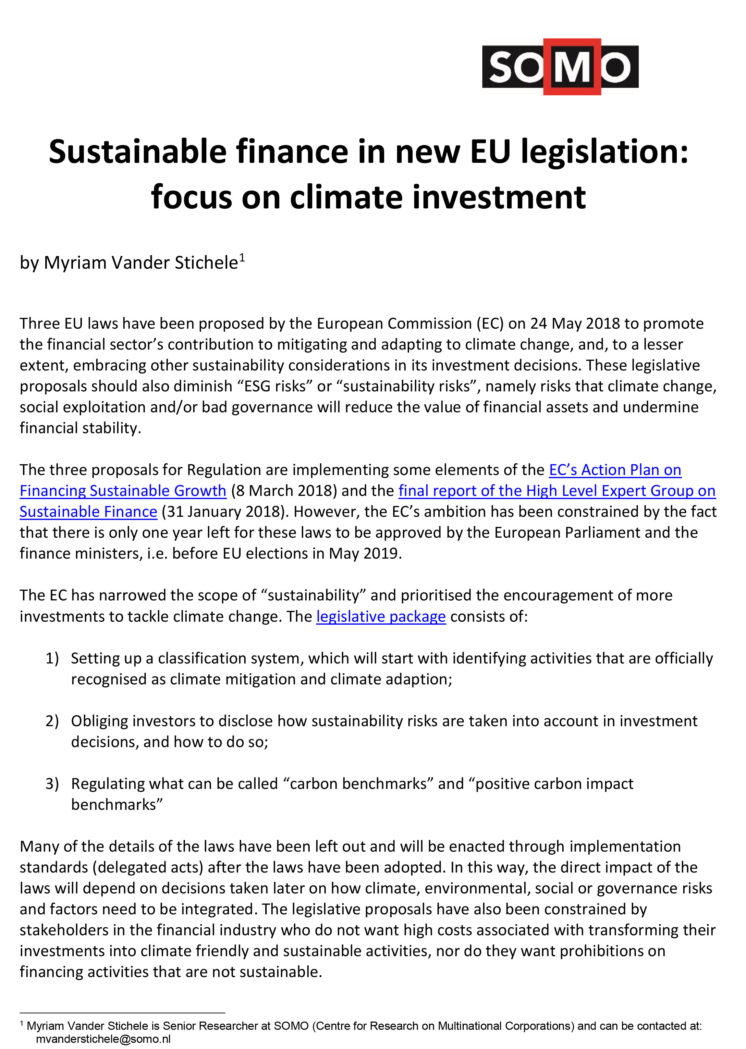
SOMO - Sustainable finance in new EU legislation: focus on climate investment - paper by SOMO includes ESG risks in investment decisions
https://www.somo.nl/sustainable-finance-new-eu-legislation-focus-climate-investment/

"The EU wants private capital to contribute to the commitments made at the Paris Climate Summit and to a certain extent, the UN Sustainability Goals.The paper written by SOMO researcher Myriam Vander Stichtele explores recent EU-legislation that should support this policy, “Sustainable finance in new EU legislation: focus on climate investment”. "
"On the 24th of May 2018, the European Commission has proposed a package of three laws that should encourage the financing of activities that tackle climate change, and to a lesser degree the financing of activities that should boost a sustainable economy. It stipulates measures to avoid greenwashing, i.e. abusive claims to be ‘green’ investments, and to integrate environmental, social and governance (ESG) risks in investment decisions. While this is a first step towards sustainable finance, these measures will not compel a massive shift in financial flows, nor comprehensively integrate sustainability in the financial sector "
Read the full report at
https://www.somo.nl/wp-content/uploads/2018/06/Sustainable-finance-in-new-EU-legislation.pdf

"The EU wants private capital to contribute to the commitments made at the Paris Climate Summit and to a certain extent, the UN Sustainability Goals.The paper written by SOMO researcher Myriam Vander Stichtele explores recent EU-legislation that should support this policy, “Sustainable finance in new EU legislation: focus on climate investment”. "
"On the 24th of May 2018, the European Commission has proposed a package of three laws that should encourage the financing of activities that tackle climate change, and to a lesser degree the financing of activities that should boost a sustainable economy. It stipulates measures to avoid greenwashing, i.e. abusive claims to be ‘green’ investments, and to integrate environmental, social and governance (ESG) risks in investment decisions. While this is a first step towards sustainable finance, these measures will not compel a massive shift in financial flows, nor comprehensively integrate sustainability in the financial sector "
Read the full report at
https://www.somo.nl/wp-content/uploads/2018/06/Sustainable-finance-in-new-EU-legislation.pdf
Thursday, 17 May 2018
Australian first stewardship code for asset owners unveiled - Superannuation and Pension scheme matters
The Australian Asset Owner Stewardship Code was developed by the Australian Council of Superannuation Investors (ACSI) in consultation with its members and other stakeholders. The Code aims to increase the transparency and accountability of stewardship activities in Australia. Stewardship activities include exercising voting rights, company engagement, monitoring asset managers and financial system advocacy.
ACSI CEO Louise Davidson said, “There is a growing desire for information about how asset owners manage the money entrusted to them. The Code raises the bar on signatories to proactively manage and disclose their stewardship activities. Beneficiaries and other stakeholders will find it easier to understand and assess the focus that asset owners have on good stewardship”.
Stewardship codes exist in many markets in the world, including the United Kingdom, United States, Japan, Hong Kong and South Africa. However, this is the first stewardship code to focus exclusively on the activities of Australian asset owners. The Code is open to all asset owners (including super funds, endowments and sovereign wealth funds), not just ACSI members.
The Code sets out six principles which signatories must commit to on an ‘if not, why not’ basis:
1. Publicly disclose how they approach their stewardship responsibilities.
2. Publicly disclose their policy for voting at company meetings and voting activity.
3. Engage with companies either directly, indirectly (for example, via collective action or third-party providers) or both.
4. Monitor asset managers’ stewardship activities.
5. Encourage better alignment of the operation of the financial system and regulatory policy with the financial interests of long-term investors.
6. Report to beneficiaries about their stewardship activities.
Signatories will be required to publish a Stewardship Statement which describes how they apply these principles. ACSI will maintain a list of signatories on our website, including a link to their Stewardship Statement and contact details.
Davidson is encouraging all asset owners to demonstrate their commitment to good stewardship by becoming signatories. She said “Australian asset owners have a long history of engaging with companies and voting their shareholdings to protect and enhance long-term value for their beneficiaries. “Signing up is an opportunity for asset owners to demonstrate that their intentions are backed by meaningful action. This is a strong basis from which to build trust and to set the tone for stewardship in Australia.”
Professor Ian Ramsay from the University of Melbourne will launch the Code in front of more than 250 conference delegates, including representatives from investors, government, academia and media. Ramsay said, “I would like to congratulate ACSI on this important initiative. Australian asset owners play a fundamental role in our financial markets and it’s good to see them take the lead in setting best practice standards for the disclosure and management of stewardship activities.”
Download the Australian Asset Owner Stewardship Code and Frequently Asked Questions
https://www.acsi.org.au/images/stories/ACSIDocuments/Stewardship_code/AAOSC_-_Final.pdf
Above media release from ACSI
ACSI CEO Louise Davidson said, “There is a growing desire for information about how asset owners manage the money entrusted to them. The Code raises the bar on signatories to proactively manage and disclose their stewardship activities. Beneficiaries and other stakeholders will find it easier to understand and assess the focus that asset owners have on good stewardship”.
Stewardship codes exist in many markets in the world, including the United Kingdom, United States, Japan, Hong Kong and South Africa. However, this is the first stewardship code to focus exclusively on the activities of Australian asset owners. The Code is open to all asset owners (including super funds, endowments and sovereign wealth funds), not just ACSI members.
The Code sets out six principles which signatories must commit to on an ‘if not, why not’ basis:
1. Publicly disclose how they approach their stewardship responsibilities.
2. Publicly disclose their policy for voting at company meetings and voting activity.
3. Engage with companies either directly, indirectly (for example, via collective action or third-party providers) or both.
4. Monitor asset managers’ stewardship activities.
5. Encourage better alignment of the operation of the financial system and regulatory policy with the financial interests of long-term investors.
6. Report to beneficiaries about their stewardship activities.
Signatories will be required to publish a Stewardship Statement which describes how they apply these principles. ACSI will maintain a list of signatories on our website, including a link to their Stewardship Statement and contact details.
Davidson is encouraging all asset owners to demonstrate their commitment to good stewardship by becoming signatories. She said “Australian asset owners have a long history of engaging with companies and voting their shareholdings to protect and enhance long-term value for their beneficiaries. “Signing up is an opportunity for asset owners to demonstrate that their intentions are backed by meaningful action. This is a strong basis from which to build trust and to set the tone for stewardship in Australia.”
Professor Ian Ramsay from the University of Melbourne will launch the Code in front of more than 250 conference delegates, including representatives from investors, government, academia and media. Ramsay said, “I would like to congratulate ACSI on this important initiative. Australian asset owners play a fundamental role in our financial markets and it’s good to see them take the lead in setting best practice standards for the disclosure and management of stewardship activities.”
Download the Australian Asset Owner Stewardship Code and Frequently Asked Questions
https://www.acsi.org.au/images/stories/ACSIDocuments/Stewardship_code/AAOSC_-_Final.pdf
Above media release from ACSI
Thursday, 3 May 2018
May News letter from Committee for Workers Capital
| |||||||||||||||||||||||||||||||||||||||
|
Subscribe to:
Posts (Atom)