|
The Innovation System of the
Public Service of Canada
Governments today are confronted with a complex array of
interconnected problems, increased citizen expectations, and fiscal
constraints. Furthermore, they must operate in a context of fast-paced
technological, geopolitical, economic, social, and environmental change.
Existing policies and ...
|

PSI Asia Pacific - Utilities - Electricity - Water & Local Government Network Bulletin Blog - The below items are published as an internal PSI Bulletin monthly or you can follow by each post by e-mail.
Showing posts with label Publications. Show all posts
Showing posts with label Publications. Show all posts
Thursday, 29 November 2018
The Innovation System of the Public Service of Canada... includes insights into Pubic Sector , Local Government , State and National innovation in other Counties


Monday, 26 November 2018
Latest OECD report on Labour Statistics - interesting trends in service Economy, Agricultural and Women's Employment
The report by the Annual Report by the OECD , is an interesting insight into the changing economies of these countries, reflecting less labour in agriculture , increased numbers in the service industry , increased Women workers participation, trends in part time employment...possibly reflecting changes in economies including those impacted by global trade,....The report can be read free on line , covers the period of 2008-2017 , published 2018 and released this past week
"
"
|
OECD Labour Force Statistics
2018
This annual edition of Labour Force Statistics provides detailed
statistics on labour force, employment and unemployment, broken down by
gender, as well as unemployment duration, employment status, employment by
sector of activity and part-time employment. It also contains participation
and ...
|

Wednesday, 7 November 2018
ILO study reveals bankruptcy of pensions privatisation
A new publication by the ILO confirms PSI’s long-held position: the privatisation of public pension systems has delivered vast returns to a tiny financial elite while diminishing the incomes of workers in retirement.


- The primary beneficiaries of privatisation are elites within societies
- Privatisation frequently facilitates and increases corruption
- Government and corporate promises of universal benefit of privatisation are inflated and under-delivered
- When governments announce privatisation, unions must prepare to fight
- Accumulated evidence shows that most privatisations can and should be defeated
- Privatisations can be reversed[i]
The privatisation of pensions has been a core element of neoliberal restructuring promoted by the World Bank, the IMF, the OECD, the Inter-American, African and Asian Development Banks, USAID and the financial services companies who derive the ultimate benefit. And, as with much of the privatisation story, Chile was the first country to privatise pensions systems under the direction of US-backed military dictator Augusto Pinochet in 1981.
Rosa Pavanelli, PSI General Secretary, notes:
The lessons for trade unions in public services are equally important:
Rosa Pavanelli, PSI General Secretary, notes:
“I want to congratulate Isabel Ortiz, Fabio Durán and their team at the ILO for this book. It starkly reveals the hypocrisy of pension privatisation, which has basically institutionalised the theft of workers’ wages. It shows the moral bankruptcy of the neoliberals, who knew exactly what they were doing. One can only feel outrage when reading the conclusions. But one also feels hope that good sense will prevail, and that the remaining countries with privatised pensions will take them back under public management – as is increasingly the case in water, energy, transport, health and other key public services.”The lessons that PSI draws from this experience are consistent with the experiences of privatisation in other sectors:
“Another aspect of this work that must be acknowledged is the evidence that when workers are not involved in decisions, we can be sure that their welfare will not be protected. Worker and trade union involvement is essential, and our job is to ensure that governments and the international agencies respect our legitimacy, especially around issues as crucial as social protection and retirement.”
The lessons for trade unions in public services are equally important:
- When governments announce privatisation, unions must prepare to fight
- Accumulated evidence shows that most privatisations can and should be defeated
- Privatisations can be reversed.
Tuesday, 9 October 2018
PSI Launches report that exposes Private Public Partnerships ( PPPs) risks and failures --- why would you use them ???

Report exposes how PPPs across the world
drain the public purse, and fail to deliver in the public interest
|
|
After the
crash, governments bailed out the banks but didn’t fix them. Finance has
refused to change its ways. The people – and our public services – have paid
the price.

Photo:
PSI/Shutterstock.com
Experts call for World Bank Group to end
aggressive promotion of PPPs for public service provision. A new report
exposing how public private partnerships across the globe have drained the
public purse and failed to deliver in the public interest will be launched at
the Annual Meetings of the World Bank in Bali next week.
History RePPPeated: How public private partnerships are
failing has been
written by experts across four continents from many civil society
organisations. They expose the negative impacts of PPPs that have often
caused misery to local communities.
The report
shows that multilateral development banks, such as the World Bank Group (WBG)
have played a leading role in providing advice and finance for PPP projects
in different sectors. This is despite the mounting evidence showing that PPPs
are expensive, risky and opaque.
Rosa
Pavanelli, Public Services International General Secretary, says:
PPPs divert
funding from the public purse to private bank accounts. Instead of creating
for-profit structures with tax payer’s money, we need investment in public
goods such as health, education and water and sanitation.
PPPs do not
deliver for communities and we call for a stop to these funding mechanisms by
the International Financial Institutions before they increase inequalities
even further.
Last year,
EURODAD launched a campaign
manifesto in which more than 150 civil society organisations from
around the world, including PSI, called for an end to the aggressive
promotion of PPPs. There is overwhelming evidence of the harm they cause.
The report
covers 10 case studies from Colombia, France, India, Indonesia, Lesotho,
Liberia, Peru, Spain and Sweden. The sectors investigated include education,
health, water and sanitation, energy and infrastructure.
Some of the
main findings are:
·
All projects came with a high cost for the
public purse, and an excessive level of risk for the public sector and,
therefore, they resulted in a heavy burden for citizens.
·
Nine out of 10 of the projects lacked
transparency and/or failed to consult with affected communities, and
undermined democratic accountability.
·
Five of the 10 projects impacted negatively
on the poor, and contributed to an increase in the divide between rich and
poor.
·
Three of the PPPs resulted in serious social
and environmental impacts.
The case
studies include the Queen Mamohato Hospital in Lesotho, which is bleeding
government coffers largely through huge costs for the treatment of patients;
and the case of Jakarta Water in Indonesia, where two PPP contracts resulted
in huge losses for the public water utility, while residents often have to rely
on groundwater from community wedge wells, or buy expensive water in jerry
cans.
The report
recommends that the WBG, the International Monetary Fund (IMF) and other
public development banks, together with the governments of wealthy countries
that play a leading role in these institutions:
·
Halt the aggressive promotion and
incentivising of PPPs for social and economic infrastructure financing,
·
Support countries in finding the best
financing method for public services in social and economic infrastructure.
·
Ensure good and democratic governance is in
place before pursuing large-scale infrastructure or service developments.
·
Ensure that rigorous transparency standards
are applied.
Access the full report including all case studies at: www.eurodad.org/historyrePPPeated or on PSI's website through
this link.

LAUNCH OF REPORT:
The report History RePPPeated: How
Public Private Partnerships are failing will be
launched at the World Bank/ IMF Annual Meetings 2018 in Bali Nusa Dua,
Indonesia.
·
Date: Wednesday
October 10th from 13.30 to 15:00
·
Where: Civil
Society Policy Forum, Bandung Room.
|
Friday, 7 September 2018
" State-Owned Enterprises and Corruption What Are the Risks and What Can Be Done? " A new publication by the OECD ... and useful where privatisation is argued for on the basis of corruption .
http://gmpsiaprec.blogspot.com/2018/09/state-owned-enterprises-and-corruption.html
The below report entitled “State-Owned Enterprises and Corruption What
Are the Risks and What Can Be Done? “ Was based on responses from over 350 state owned enterprises , from 34 countries across Asia including Korea, Pakistan, Philippines, Japan, and includes a check list
used by the UK Government ,as well as a number of examples of standards and actions from across Europe …. The publication covers and dispels the arguments that ‘privateers’ and
those in Government that support privatisation often argue that, corruption can
be avoided by privatisation.
This report is a useful
tool to Union Colleagues and those in society promoting anti privatisation
arguments …as use of this report along with many of the arguments and issues raised
can or could be adopted by Governments to strengthen anti privatisation
arguments in State Owned Enterprises, (including state owned electricity and
other utility services corporations)
The report is a great contribution to ‘ anti-corruption’ , includes methods
, measures, quotations, useful ideas and drivers …. It is highly useful in changing
corrupt direction and attitudes as well as strengthening public sector ownership…
The full report can be found at https://doi.org/10.1787/9789264303058-en
OECD Publication advice including links and brief intro is
reprinted below
|
State-Owned Enterprises and
Corruption
What Are the Risks and
What Can Be Done?
Corruption is the antithesis of good governance, and it is a
direct threat to the purpose of state ownership. This report brings a
comprehensive set of facts and figures to the discussion about the corruption
risks facing state-owned enterprises (SOEs).
|

Thursday, 30 August 2018
PSI contribution " Subsidising the rich: how workers pay the price for corporate tax dodging" by Daniel Bertossa Director of Policy and Governance at Public Services International
" Public Services International (PSI) recently served as guest editor of the International Centre for Trade Union Rights Journal, writing on the theme of tax justice.
Inside this issue of the Journal are a range of articles from academics, activists and union officials which outline why the fight for tax justice is important for our movement and showcase a series of recent wins against corporate tax greed." - Advice from PSI Asia Pacific face book .
You can view the Journal by clicking http://www.world-psi.org/…/docume…/research/iur_25-1_002.pdf

Wednesday, 29 August 2018
" Private thermal power generation in India – boon or bane? " A paper prepared by K Ashok Rao , Patron, All India Power Engineers Federation
https://drive.google.com/open?id=1GIJYhHQ8vI4ddRTXOBy-VTKaFGnEbMdi
This paper (via above link) prepared by Ashok Rao, is one of number of publications prepared by Ashok as part of the debate on the benefit of publicly owned base load power plants in India .
The paper covers issues surrounding -
* Legislative changes for the Industry by the Indian Government, and what that has meant for the industry on the ground including
* Private power plants = Public money, private management.
* The Import of equipment and its consequences, including the affect of imports on the local suppliers, constructors and manufactures
* Questions of Over invoicing of coal and equipment
* What then is our responsibility as citizens? And conclusion
This paper (via above link) prepared by Ashok Rao, is one of number of publications prepared by Ashok as part of the debate on the benefit of publicly owned base load power plants in India .
The paper covers issues surrounding -
* Legislative changes for the Industry by the Indian Government, and what that has meant for the industry on the ground including
* Private power plants = Public money, private management.
* The Import of equipment and its consequences, including the affect of imports on the local suppliers, constructors and manufactures
* Questions of Over invoicing of coal and equipment
* What then is our responsibility as citizens? And conclusion
The conclusions includes references to the role of the IMF and World Bank and its " structural adjustment loan conditionalities laid down by the World Bank and the IMF " which ensured the withdrawal of State resources from development of a vital infrastructure – the power supply industry.Plus the question of other Governments to support their national , third party party players .
The links of Trade, IMF, World Bank , direct and indirect consequences , plus third party players support .
The paper is well worth a read and use as a resource materiel for Unions and Society in general but in particular for Asia Pacific Nations still building their electricity industry as part of their development
Ashok Roa can be contacted akashokrao@gmail.com
The links of Trade, IMF, World Bank , direct and indirect consequences , plus third party players support .
The paper is well worth a read and use as a resource materiel for Unions and Society in general but in particular for Asia Pacific Nations still building their electricity industry as part of their development
Ashok Roa can be contacted akashokrao@gmail.com
Monday, 27 August 2018
OECD Publication - roles of Cities and Regions in delivering on Sustainable Development Goals (SDGs)
|
Reshaping Decentralised Development Co-operation
The Key Role of Cities and Regions for the 2030 Agenda
Over the last decades, and in line with the adoption of the Sustainable Development Goals (SDGs) in 2015, cities and regions have played an important part in helping to implement global agendas at local level through their Decentralised Development Cooperation (DDC) activities.
Read and Share . " This report, while heavily European focused, provides examples of cross Local Government cooperation , including internationally, the role of UN - Habitat and reminds us of the role of Local Government in delivering on the UN Sustainable Development Goals. The report is well worth a read, for those interested in this debate, provides number of examples and quotes, including Local Government working with other Local Governments (PUPs as alternatives to the failed PPP's model) as well as Local Authorities working with NGOs, in traditional development models " - Greg Mclean If the above link does not work please use https://read.oecd-ilibrary.org/urban-rural-and-regional-development/reshaping-decentralised-development-co-operation_9789264302914-en#page1 (The above OECD advice, is provided from the OECD New Publications Bulletin) |

Thursday, 26 July 2018
Investing Superannuation (pension funds) for the Public Good - " Ideal investments for superannuation funds and borrowing vehicles for local and state governments to fund public assets without controversial privatisation."

The McKell Institute (based in Australia) has prepared a paper entitled
Investing Superannuation for the Public Good: Creating new markets to benefit members and fund necessary investments by Professor Anthony Asher (Associate Professor at the UNSW Business School) and Esther Rajadurai of the McKell Institute.
The report was sought to look at the increasing role and opportunities that Superannuation Funds can play in the development of infrastructure , including Public Sector Owned and Operated.
Report Conclusion - (extract from report )
" Over the past few decades, there has been a significant shift in attitudes towards investments and superannuation. Ethical investing has become part of the mainstream and increasingly, members of super funds are determined to make sure that their super funds are invested in ethical, social and responsible companies and funds. Trustees have increasingly made more explicit commitments to monitoring the risks posed by ESG issues and making positive impacts in their choice of investments. These fulfill their fiduciary obligations to seek the best financial interests of their beneficiaries and are by no means restricted by the Sole Purpose Test.
Infrastructure is already beginning to take its place as a separate asset class, and trustees can use their significant assets more intentionally, in assisting governments fund public infrastructure.
This report suggests that Indexed Annuity Bonds can be adapted to provide lower risk inflation linkages for borrowers and longevity protection for investors. As such, they would be ideal investments for superannuation funds and borrowing vehicles for local and state governments to fund public assets without controversial privatisation.
The call is for trustees and governments to collaborate to develop a market in these instruments that benefits superannuation members and encourages the development of appropriate infrastructure.
Global capital is a dominant force in the world today and the capital invested and held by super funds can be used for the good of the nation. Through proper stewardship of the assets and government collaboration, super funds can be managed to create sustainable and long term value for their members and the broader community "
The report was prepared due to sponsorship from UNIONS NSW, and is a project pursed by The Unions NSW Superannuation Committee , which includes Australian PSI Affiliates based in the State of New South Wales (NSW)
Monday, 14 May 2018
TUED Working Paper #11 | Trade Unions and Just Transition: The Search for a Transformative Politics
http://unionsforenergydemocracy.org/wp-content/uploads/2018/04/TUED-Working-Paper-11.pdf
Latest paper from Trade Unions for Energy Democracy ( TUED ) by Sean Sweeney and John Treat

Latest paper from Trade Unions for Energy Democracy ( TUED ) by Sean Sweeney and John Treat

"In late 2015, after more than a decade of tenacious lobbying of
government negotiators, union representatives led by the International Trade
Union Confederation (ITUC) succeeded in getting the phrase “Just Transition”
into the preamble to the Paris Climate Agreement negotiated at COP21. The text
affirmed “the imperatives of a just transition of the workforce and the
creation of decent work and quality jobs in accordance with nationally defined
development priorities.”
More than two years have passed since COP21, and calls for a Just
Transition have emerged from all corners of the global progressive community.
Once more or less exclusively a trade union priority, calls for a Just
Transition increasingly appear, in varying forms, in the campaigns of major environmental
organizations, climate justice and green NGOs, and indigenous and farmers’
movements. However unevenly, Just Transition has begun to feature in
discussions around national politics and policy, and unions increasingly refer
to the current period as Just Transition’s “implementation phase.”
The Need
for an Integrated and Transformative Politics
Unions for the most part understand that they must strive to
develop a Just Transition politics that somehow addresses the immediate
concerns of workers while keeping the need for a transition of the entire
economy in view. A transition that is “just” from the perspective of workers or
“the workforce,” but which fails to help achieve the needed socioeconomic
transformation, will ultimately accomplish little to address pressing
climate-related and broader ecological concerns. Alternatively, policies aimed at
driving a socioeconomic transformation that are robust enough to achieve
climate and environmental targets, but which ignore the impact on workers in
specific locations or industries, risk being unable to secure the support from
workers that such a transformation requires in order to be successful.
“Social Dialogue” or
“Social Power”?
In this eleventh TUED Working Paper, we argue that, in order to
effectively achieve this full range of aims, the international trade union
movement must collectively formulate and pursue a comprehensive, integrated
approach. Doing so requires a sober examination of the origins and current
state of debates over Just Transition.
Unions at all levels of the international trade union movement
recognize that a broad transformation of our economy and society is urgently
necessary. But the insistence on keeping “Social Dialogue” at the center of
such discussions holds trade union debates captive to the narrative of the
liberal business establishment, and to a very narrow and de-mobilizing
interpretation of Just Transition. Anchored in the particular realities of
post-war Europe, Social Dialogue has been effectively elevated to the status of
an official ideology in recent years–one that is increasingly out of step with
both the challenges facing workers and their organizations, and the pressing
demands for action posed by the climate and ecological crisis more broadly.
This paper makes the case for a different and more expansive trade
union conversation-one that can address worker-focused concerns while advancing
deeper socioeconomic transformation. We call this the “Social Power” approach.
This approach is guided by the belief that a Just Transition cannot be
accomplished without a deep restructuring of the global political economy. Existing
power and ownership relations must be challenged and changed. This is, of
course, an extremely difficult task. But if this does not occur, then the vast
majority of the world’s working people will never see anything vaguely
resembling a Just Transition. We can at least begin by openly acknowledging
that this needs to be our movement’s long term goal and then organize
accordingly.
The paper offers examples from around the world that illustrate
how this new approach is cohering within day-to-day trade union struggles, as
well as at the level of ideas across the political left. "
Above Introduction from TUED
Above Introduction from TUED
Monday, 30 April 2018
Public Services International Research Unit
Our Colleagues at the PSIRU have a new website at .....
Which features not just new but it's old reports dating back over twenty years to 1996....
The reports including the works for PSI cover the range of PSI areas including Electricity, Water and Local Government.
All reports can be located at https://www.gre.ac.uk/
The report's are important documents to provide many arguments supporting anti privatisation, the failures of PPPs , how Communities have missed out through Governments using the failed privatisation model along with PPPs and contracting out of Utility and Local Government Services
It is an important web site, which reflects the solid support by PSI for Affiliates Sectors and PSI as the Global Union Federation for Public Services including Electricity, Water and Local Government
Reports can be down loaded , shared and used to show NGOs, Non Public Sector Unions, Government Officials and the Broad Community that the messages delivered by PSI are well supported ...
Papers and reports include those prepared by -
Dr. Jane Lethbridge Director, Public Services International Research Unit
Privatisation and outsourcing of public services, including health and social care; social dialogue; digitalisation and future work; democratic professionalism in public services
Privatisation and outsourcing of public services, including health and social care; social dialogue; digitalisation and future work; democratic professionalism in public services
Prof. David Hall Visiting Professor, PSIRU Associate. Impact of liberalisation and privatisation on public services, especially water and energy; public-private partnerships; trade agreements and public services; corruption
Prof. Steve Thomas Professor, Energy Policy, PSIRU associate Economics and policy on nuclear power; liberalisation of energy markets; corporate policies of European energy companies.
Greg McLean
Monday, 16 April 2018
The EU-Indonesia CEPA negotiations a report by SOMO - IGJ Indonesia for Global Justice - TNI The Transnational Institute
https://www.somo.nl/eu-indonesia-cepa-negotiations/?utm_source=SOMO+Newsletter&utm_campaign=d78d95c017-EMAIL_CAMPAIGN_2018_03_20&utm_medium=email&utm_term=0_ba1b8b451d-d78d95c017-229548005
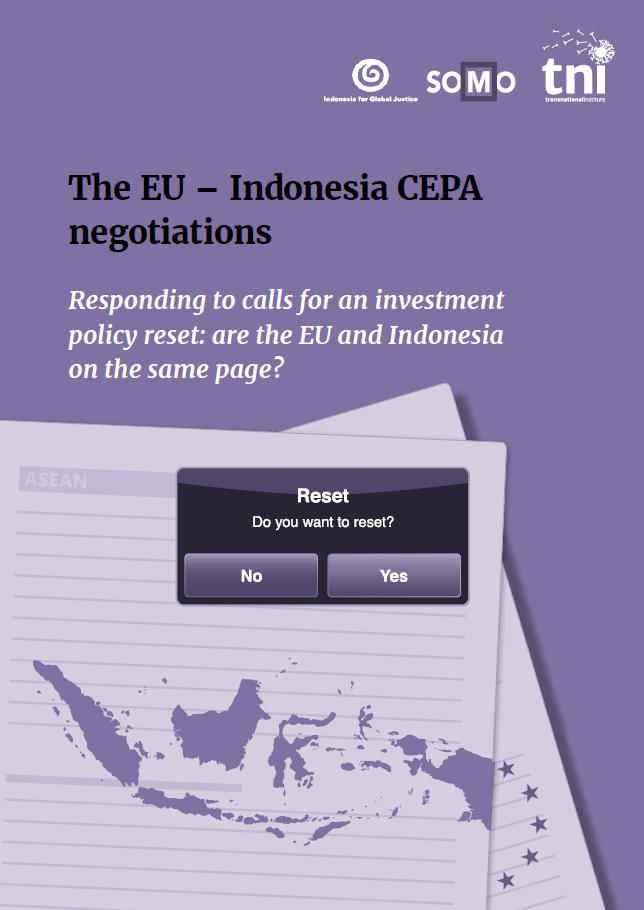
The paper written by Bart-Jaap Verbeek, who according to SOMO , " is a specialist in the transnational governance of trade and investment and the impact on labour, environment, democracy, and human rights. In particular, and examines how trade and investment agreements enhance and protect transnational capital flows and what the implications are for equitable and sustainable economic development."
In this paper he " explores the agenda driving the negotiations for an Indonesia-Europe Comprehensive Economic Partnership Agreement (CEPA) in relation to investment and discusses the merits of alternative investment protection frameworks as proposed by Indonesia and other countries in relation to promoting more equitable and sustainable development."
The paper written by Bart-Jaap Verbeek, who according to SOMO , " is a specialist in the transnational governance of trade and investment and the impact on labour, environment, democracy, and human rights. In particular, and examines how trade and investment agreements enhance and protect transnational capital flows and what the implications are for equitable and sustainable economic development."
In this paper he " explores the agenda driving the negotiations for an Indonesia-Europe Comprehensive Economic Partnership Agreement (CEPA) in relation to investment and discusses the merits of alternative investment protection frameworks as proposed by Indonesia and other countries in relation to promoting more equitable and sustainable development."
The paper includes references on Public Services Provision , Human Rights and more . It is an excellent read and of benefit to those concerned on the international trade debate
Tuesday, 27 March 2018
Seminar and report , watch the video : Local Government Workforce - the Trends and the Blips on the Radar - Australia
Update new report - In the last week the University of Technology Sydney - UTS - Institute for Public Policy and Governance (IPPG) / UTS Centre for Local Government, launched key report on the Australian Local Government Workforce. PSI AP Utilities and Local Government Network was there.
The presentation was given by (below) Alex Lawrie, Lisa Conolly, and over sighted/facilitated by Professor Roberta Ryan ( who has made past presentations to PSI AP LG Affiliates, including by video links ). The UTS IPPG has also worked with a range of Government in the Asia Pacific Region, including on the basis of building Local Government Workforce's.
The recent presentation, was not focused on contractors or privateers but rather Local Government direct employed staff, the important benefits this direct employment has for the community, including staff living in these communities, less travel time and environmental damage, more monies spent locally, more jobs in local communities and skills development, gender equity , indigenous employment and much more.
The report would be of interest to anyone following the argument of Local Government direct employment and re-municipalisation , NO matter their Country .
See the full story below and watch the video
https://www.uts.edu.au/research-and-teaching/our-research/institute-public-policy-and-governance/news/local-government-5
Local Government Workforce: the Trends and the Blips on the Radar

The presentation was given by (below) Alex Lawrie, Lisa Conolly, and over sighted/facilitated by Professor Roberta Ryan ( who has made past presentations to PSI AP LG Affiliates, including by video links ). The UTS IPPG has also worked with a range of Government in the Asia Pacific Region, including on the basis of building Local Government Workforce's.
The recent presentation, was not focused on contractors or privateers but rather Local Government direct employed staff, the important benefits this direct employment has for the community, including staff living in these communities, less travel time and environmental damage, more monies spent locally, more jobs in local communities and skills development, gender equity , indigenous employment and much more.
The report would be of interest to anyone following the argument of Local Government direct employment and re-municipalisation , NO matter their Country .
See the full story below and watch the video
https://www.uts.edu.au/research-and-teaching/our-research/institute-public-policy-and-governance/news/local-government-5
Local Government Workforce: the Trends and the Blips on the Radar
In 2011, councils were amongst the largest employers in about 10% of all Local Government Areas nationally. Local government was also the only level of government to have met the Council of Australian Governments’ public sector targets for Indigenous employment. And the sector was well placed to smash the glass ceiling that often prevents gender equity in senior ranks.
But how is the workforce shaping up five years on? Workforce data specialists from the University of Technology Sydney (UTS) Centre for Local Government and the Australian Bureau of Statistics (ABS) addressed this question in a recent seminar at UTS.
Lisa Conolly from ABS and Alex Lawrie from UTS drew on a unique set of ABS workforce data stretching across multiple Censuses to highlight trends shaping where local government is headed.
Some interesting findings from the Census data in relation to local government workforce include:
- In 2011 and 2016, local government was the only level of government to have met Council of Australian Government targets for Indigenous employment in the public sector.
- The 2011 Census data revealed a large group of highly educated women in lower and middle management. These workers have now started moving into senior management positions and there are almost 10% more female general managers in local government today than there were in 2011.
- There are over 420 local government areas where more than half the council workforce also lives local. This has great outcomes in terms of efficiency and quality of life as people can find jobs closer to where they live.
Watch the seminar video
Seminar resources:
Thursday, 22 March 2018
The End of Water Privatisation?
http://www.world-psi.org/en/end-water-privatisation
 Just look at the meltdown of many privatisations in the UK: even the Conservative Environment Secretary Michael Gove is chastising the behaviour of privatised water utilities. He recently highlighted how tariffs are too high, financial manipulations and tax avoidance are endemic, shareholder dividends swallow most of the profits, and CEOs pay themselves exorbitant salaries. And this from the party of Margaret Thatcher.


Yet the United Nations and many governments still seem convinced that we need Public-Private-Partnerships (PPPs) and private finance to achieve the Sustainable Development Goals (SDGs). They remain deluded by the false promises of PPPs, even as the evidence of the crisis of privatisation is mounting.
A recent report published by Public Services International and the Transnational Institute shows that since 2000 there have been at least 235 cases of water remunicipalisation in 37 countries, affecting more than 100 million people. So what’s driving this trend?
The motivations for ending privatisation in the water sector include cost savings, improved quality of service, financial transparency, and regaining operational capacity and social control. Environmental objectives, such as speeding up renewable development or reducing waste are other key drivers. And of course, providing social tariffs for low-income households (where many families cannot afford the high utility bills) is another key reason.
Furthermore, there’s mounting empirical evidence that remunicipalisation across the public sector makes economic sense. The termination of transport PPPs in London resulted in a £1 billion reduction in costs, mainly through the elimination of shareholder dividends and legal fees. In Canada, after the Government decided to build four schools via public provision rather than through PPPs, the savings were enough to build an entire new fifth school.
Yet the unfortunate reality is that over one billion people remain without access to safe water. In 2015 the UN endorsed universal access to water by 2030 as one of its Sustainable Development Goals. How can we ensure our public water operators are able to deliver?
We need to demand a fairer global tax system, so we can invest in essential infrastructure such as modern water utilities. Failure to do so can lead to devastating consequences such as in Flint, Michigan where cost-cutting paired with a hefty corporate tax cut led to the poisoning of thousands of (mainly poor) people. Another key step is to remove public services from trade deals, which often dissuade or penalize governments for acting in the public interest. Finally, Public-Public Partnerships between water utilities can assist in sharing of both best practices and resources.
The turning tide in the privatisation debate is welcome news to workers, unions and the wider public. Now we need to convince global leaders to go with the flow.
On World Water Day, 22 March 2018, PSI and affiliates gathered at the Alternative World Water Forum in Brasilia, to work with unions and communities fighting for social justice, in Brazil, in Latin America and across the planet.
Says Margarita Lopez, President of the water union Sintracuavalle in Colombia, “We join our Brazilian colleagues in denouncing the assassination of Marielle Franco, the young City Councillor of Rio de Janeiro and her driver. Regrettably, our opponents are too willing to kill unionists, environmental activists, and young political leaders. The levels of violence are increasing. But we will not be silenced, we will not be cowed. The fight for social justice continues, including the fight for public water and sanitation.”Luis Isarra, President of the water union FENTAP in Peru said, “It is ironic that the push for privatisation is receding. Earlier this week (13 March 2018), the water privatisation of Tumbes, Peru came to a crashing halt, as the companies pulled out in defeat. And it is the same Minister of Water, Carlos Bruce, that we warned 12 years ago against the Tumbes privatisation, who announced the return to public management.”Says Edson Aparecido da Silva of the municipal workers union FNU, “Brazil is going against the trend: while the world is bringing water services back in public ownership and management, Brazil under Temer is privatising as fast as it can. Our union FNU is waging a valiant battle in every community, to raise awareness of the threats and to push for stronger social control of public utilities. We are in a very difficult political context, where corporate control is growing, at all levels, including in the U.N.; where rising inequality is leading to toxic political movements seeking to divide and exclude; where governments shut down spaces for free expression. But our movement for water justice is built in the workplace and in the community, with too many voices to be silenced. "
David Boys will also speak in the ‘commercial’ World Water Forum, to denounce the privatisation and commodification of water services and resources.
Says Boys, “Policy makers need to get their heads out of the corporate trough and listen to what our members and our families really need. We don’t want our water – or other public services to be run for the profits of the few. The privatisation mania has got to stop. One step we can take is to build a global tax system, so that the rich and the corporations pay their fair share into the public coffers. Another step is to remove public services from the trade deals. And, we will hold our elected officials and their public appointees to account, to ensure they deliver on their obligations, whether in water and sanitation, in health and social services, in transport, in justice...”
Posters
Subscribe to:
Posts (Atom)