|
The Innovation System of the
Public Service of Canada
Governments today are confronted with a complex array of
interconnected problems, increased citizen expectations, and fiscal
constraints. Furthermore, they must operate in a context of fast-paced
technological, geopolitical, economic, social, and environmental change.
Existing policies and ...
|

PSI Asia Pacific - Utilities - Electricity - Water & Local Government Network Bulletin Blog - The below items are published as an internal PSI Bulletin monthly or you can follow by each post by e-mail.
Thursday, 29 November 2018
The Innovation System of the Public Service of Canada... includes insights into Pubic Sector , Local Government , State and National innovation in other Counties


Monday, 26 November 2018
Latest OECD report on Labour Statistics - interesting trends in service Economy, Agricultural and Women's Employment
The report by the Annual Report by the OECD , is an interesting insight into the changing economies of these countries, reflecting less labour in agriculture , increased numbers in the service industry , increased Women workers participation, trends in part time employment...possibly reflecting changes in economies including those impacted by global trade,....The report can be read free on line , covers the period of 2008-2017 , published 2018 and released this past week
"
"
|
OECD Labour Force Statistics
2018
This annual edition of Labour Force Statistics provides detailed
statistics on labour force, employment and unemployment, broken down by
gender, as well as unemployment duration, employment status, employment by
sector of activity and part-time employment. It also contains participation
and ...
|

Sunday, 25 November 2018
25 November - International Day for the Elimination of Violence against Women.
Ending workplace violence and harassment in public services


A few months ago, two young women health workers were executed by a Boko Haram faction in Nigeria. Saifura Hussaini Ahmed Khorsa, 25, and Hauwa Mohammed Liman, 24, were both midwives with the International Committee of the Red Cross (ICRC) in the state of Borno and were abducted in March along with the UNICEF nurse Alice Loksha, who is still alive.
At the time of their abduction, all three were providing essential prenatal care to communities in Rann, a small town whose population has more than doubled since it became the location for a camp of around 45,000 internally displaced people. Saifura, as her father said, “was serving humanity”.
The deaths of Saifura and Hauwa were the latest and tragic examples of the dangers faced by workers when delivering public services. However, it is not only in the extreme conditions of conflict zones that workplace violence occurs, although the health sector, which has a predominantly female workforce, is particularly affected.
So much so that the World Health Organization (WHO) calculates that violence in this sector accounts for 25% of all incidents at the workplace.
“Violence is not only perpetrated by those who are directly involved in labour relations, such as managers and colleagues, but also by patients, family members and visitors”, says Irene Khumalo, the new Chair of the PSI’s World Women’s Committee and member of the Swaziland Democratic Nurses’ Union.
Khumalo notes that wars, internal conflicts and economic crises make the situation worse.
ILO Convention
It is in this context and on the International Day for the Elimination of Violence Against Women that PSI reiterates its commitment to the discussion and adoption of a Convention and Recommendation to End Violence and Harassment in the World of Work by the International Labour Organization (ILO) in 2019.
We believe that this convention should be seen as the outcome of the long struggle by women in the international trade union movement for an instrument that addresses gender-based violence as a multi-sectorial and systemic issue in the world of work.
Women began this journey a long time before 2015, when the ILO’s Governing Body decided to put discussion of the instrument on the agenda of the International Labour Conference (ILC) in 2018. The initial focus was gender-based violence, but the ILO broadened the scope, form and content of the discussion to include the world of work as a whole in order to address the many manifestations of violence.
Tax Justice
PSI argues that sufficient resources must be allocated to basic services like health care if they are to have the material foundations necessary to function without the threat of violence against either workers or service users. It also calls for the formulation of public policies able to provide gender-responsive public services.
In this context, PSI General Secretary Rosa Pavanelli emphasises that:
“PSI is part of the global movement for Tax Justice that advocates for States to recover resources stolen through tax avoidance and evasion and that are needed for investment in quality public services.”
Marginalised groups
Clare Middlemas, youth representative on PSI’s World Executive Board and a member of the SPSF union in Australia, says it is also essential
“to continue with the work of fully including young workers, migrants, indigenous and African peoples and LGBTI workers, in the list of groups recognised as being especially vulnerable to violence and harassment at work.”
Download our posters
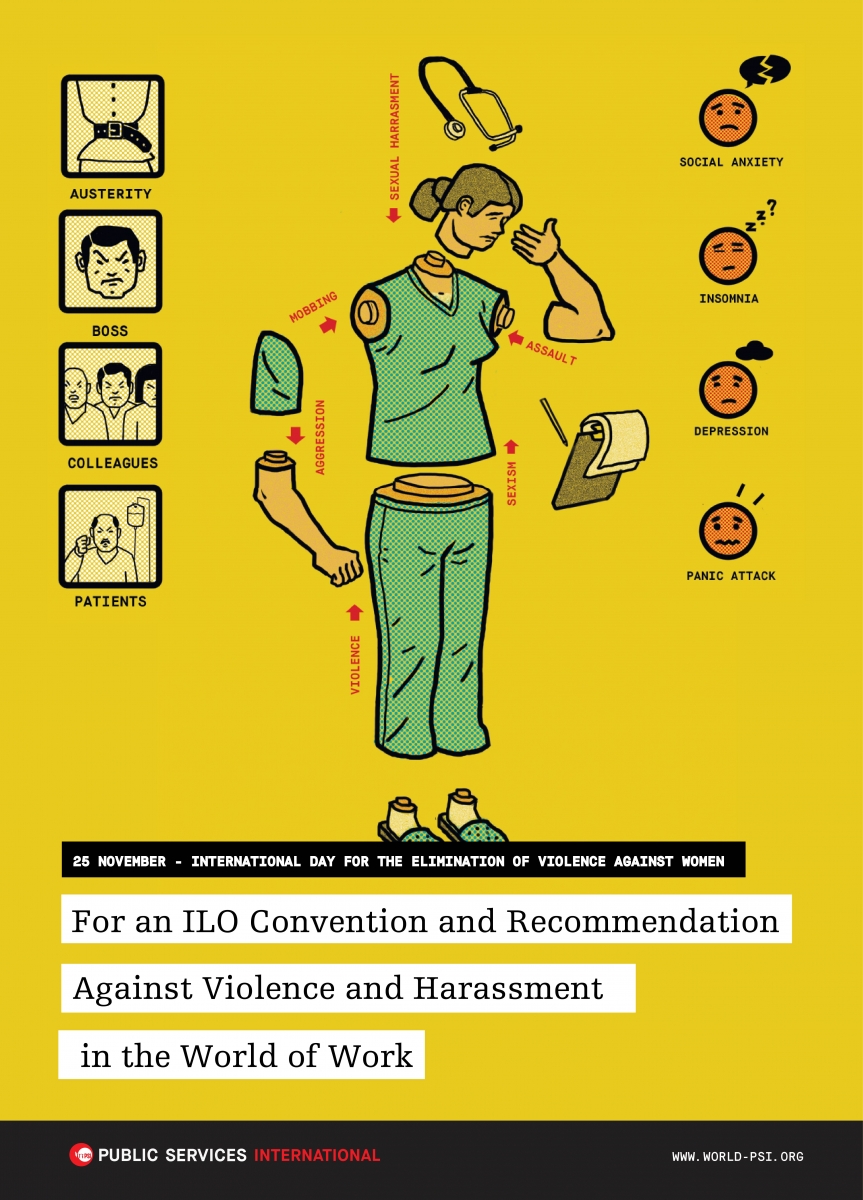
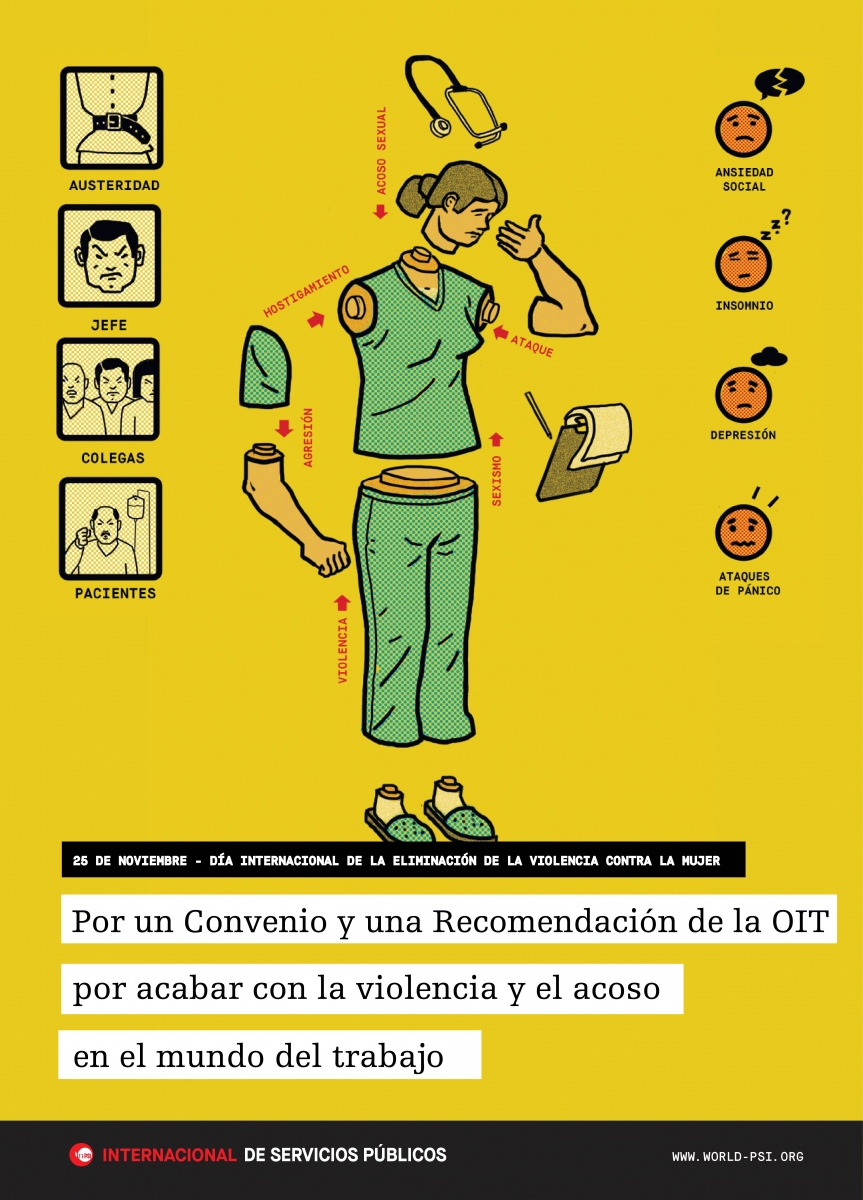
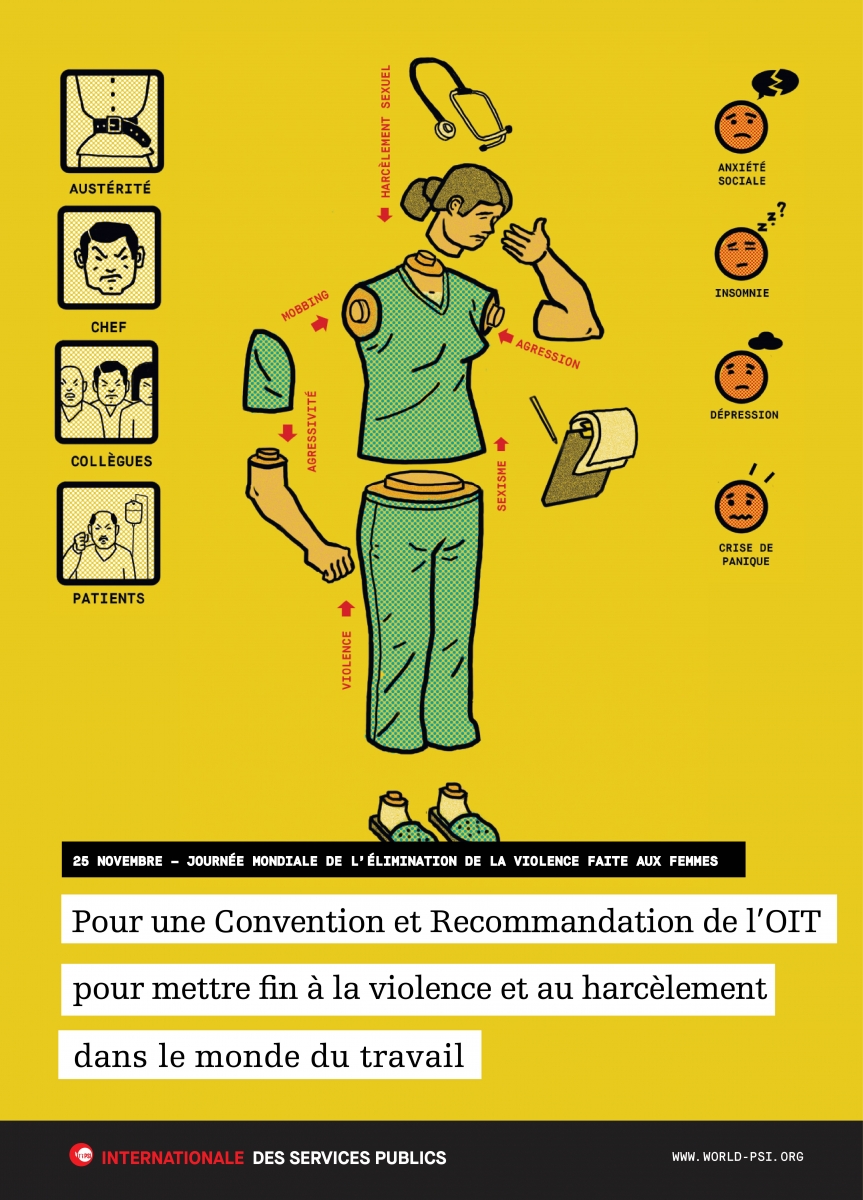
For more information, see:
- PSI’s pages on Ending violence against women
- PSI’s campaign materials calling for an ILO Convention and Recommendation to End Violence and Harassment in the World of Work
- PSI publication “Tackling gender-based violence in the world of work – experiences in the health sector”
- PSI publication “Tax justice and gender justice in Africa: Study on tax and public services impact on women and girls in Ghana”
- 6th Violence in the Health Sector conference: A commitment to collective action to eliminate workplace violence in the health sector
Friday, 23 November 2018
European Court of Human Rights Re-affirms Right to Strike in Key Decision
Brussels, 23 November 2018 (ITUC OnLine): The European
Court of Human Rights (ECHR) has issued, on 20 November, a key ruling in
defence of the right to strike in the railway sector in a case concerning a
train driver in Russia.
Anatoly Ognevenko, a member of the Russian locomotive
railway union RPLBZh, was dismissed from his job in Moscow on April 28 2008
after he participated in a one-day strike over wages. While the Russian courts
did not challenge the legality of the strike, they nevertheless refused to
declare his dismissal unlawful. The case, which was opened at the ECHR in 2009,
was based on an analysis of formal compliance with the relevant Russian laws.
It concluded with the finding that the dismissal was a disproportionate
restriction on Ognevenko’s right to freedom of association.
The Court once again confirmed that the right to
strike falls under the protection of Article 11 of the European Convention on
Human Rights as an important aspect of the right to freedom of association by
basing itself on the ILO supervisory bodies, which consider the right to strike
as an indispensable corollary of the freedom of association.
The Court also noted that the ILO regularly criticised
Russian legislation banning railway workers’ right to strike. It declared that
there is no reason to reject the existing international approach to the
definition of an essential service and to consider the railway transport as
such.
“The right to strike is fundamental, and as with other
basic workers’ rights, it is under attack in many parts of the world. This
decision from the ECHR re-affirms the right to strike, based in international
law with the jurisdiction of the International Labour Organization. We welcome
the decision, in the full knowledge that the rule of law means that the right
to strike must be respected,” said Sharan Burrow, ITUC General Secretary.
For more information: https://perc.ituc-csi.org/KTR-dismissal-of-a-unionist-in-Russia-rendered-illegal-by-EHCR
The ITUC
represents 207 million members of 331 affiliates in 163 countries and
territories.
Follow us on the web: www.ituc-csi.org and www.youtube.com/ITUCCSI
For more information, please contact the ITUC Press Department on +32 2 224 02 53 or by e-mail: press@ituc-csi.org
For more information, please contact the ITUC Press Department on +32 2 224 02 53 or by e-mail: press@ituc-csi.org
Friday, 9 November 2018
Pakistan PSI Affiliate - WAPDA pushes for extra 'superannuation benefits ' , additional housing , increase in wages and pensions

The above article was published in the ' Nation' , newspaper Pakistan 4th November, supplied by Osama Tariq Secretary, All Pakistan Workers
Confederation (Regd) , Bukhtiar Labour Hall
28 Nisbet Road Lahore Pakistan. pwf@brain.net.pk
Thursday, 8 November 2018
India - Nagpur Municipal Corporation... more on PPPs and their failures - From PSI AP face book page
(Credit: Jammu Anand, Nagpur Municipal Corporation Employees Union)


Wednesday, 7 November 2018
ILO study reveals bankruptcy of pensions privatisation
A new publication by the ILO confirms PSI’s long-held position: the privatisation of public pension systems has delivered vast returns to a tiny financial elite while diminishing the incomes of workers in retirement.


- The primary beneficiaries of privatisation are elites within societies
- Privatisation frequently facilitates and increases corruption
- Government and corporate promises of universal benefit of privatisation are inflated and under-delivered
- When governments announce privatisation, unions must prepare to fight
- Accumulated evidence shows that most privatisations can and should be defeated
- Privatisations can be reversed[i]
The privatisation of pensions has been a core element of neoliberal restructuring promoted by the World Bank, the IMF, the OECD, the Inter-American, African and Asian Development Banks, USAID and the financial services companies who derive the ultimate benefit. And, as with much of the privatisation story, Chile was the first country to privatise pensions systems under the direction of US-backed military dictator Augusto Pinochet in 1981.
Rosa Pavanelli, PSI General Secretary, notes:
The lessons for trade unions in public services are equally important:
Rosa Pavanelli, PSI General Secretary, notes:
“I want to congratulate Isabel Ortiz, Fabio Durán and their team at the ILO for this book. It starkly reveals the hypocrisy of pension privatisation, which has basically institutionalised the theft of workers’ wages. It shows the moral bankruptcy of the neoliberals, who knew exactly what they were doing. One can only feel outrage when reading the conclusions. But one also feels hope that good sense will prevail, and that the remaining countries with privatised pensions will take them back under public management – as is increasingly the case in water, energy, transport, health and other key public services.”The lessons that PSI draws from this experience are consistent with the experiences of privatisation in other sectors:
“Another aspect of this work that must be acknowledged is the evidence that when workers are not involved in decisions, we can be sure that their welfare will not be protected. Worker and trade union involvement is essential, and our job is to ensure that governments and the international agencies respect our legitimacy, especially around issues as crucial as social protection and retirement.”
The lessons for trade unions in public services are equally important:
- When governments announce privatisation, unions must prepare to fight
- Accumulated evidence shows that most privatisations can and should be defeated
- Privatisations can be reversed.
Tuesday, 6 November 2018
PSI Affiliate - Pakistan WAPDA Electricity Union argues for more safety inspection of equipment , amendment of outdated Pakistan Labour laws, increased wages and pensions

The above article has been supplied by WAPDA and was originality published in the ' DAWN ' newspaper in Lahor , Pakistan on the 4th November . Supplied by Osama Tariq Secretary All Pakistan Workers Confederation (Regd) - Bukhtiar Labour Hall 28 Nisbet Road Lahore Pakistan. pwf@brain.net.pk
Monday, 5 November 2018
October 2018 News items - Blog Bulletin - PSI - Asia Pacific - Electricity – Water - Local Government
https://drive.google.com/open?id=1_2lHULK4Q_I55Xp11lhbs9BydfPknr5p
The latest edition of PSI Asia Pacific Utility Electricity & Water / Local Government Bulletin is now available in pdf at the above link.
The Bulletin is created from items and links published over the last month at http://gmpsiaprec.blogspot.com Thanks to all that have contributed to this edition, contributions are always welcome.
Feel free to distribute to others and add your additional comments, as well as visiting the blog site http://gmpsiaprec.blogspot.com between receiving bulletins or to down load the full news item.
Friday, 2 November 2018
Radio Labour - This week includes How municipal unions can fight perilous work

RadioLabour's World Report for the week October 29 to November 2, 2018 has been posted.
* Labour wants UN to help stop the killing of journalists
* How municipal unions can fight perilous work
* The LabourStart report about union events
* And singing: "The Workers’ Song"
The World Report is available at: http://www.radiolabour.net/rl-world-021118.html
Wednesday, 31 October 2018
PSI - UN World Cities Day 2018,
https://tinyurl.com/y8c9azv3
On UN World Cities Day 2018, PSI calls the United Nations, governments and mayors to halt the widespread use of precarious work in local and regional government services that hurts local communities, undermines the quality and accessibility of local public services, and stands in the way of achieving sustainable, inclusive and resilient cities (SDG11).
On UN World Cities Day 2018, PSI calls the United Nations, governments and mayors to halt the widespread use of precarious work in local and regional government services that hurts local communities, undermines the quality and accessibility of local public services, and stands in the way of achieving sustainable, inclusive and resilient cities (SDG11).

Monday, 29 October 2018
Indonesia - bringing water back to the public.
PSI affiliate in water sector SP PDAM - Jakarta together with other unions from Aetra Palyja Workers Union (PUK SPSI Aetra, PUK SPSI Palyja and Sekar Aetra) met at Hotel Oria, Jakarta. The two-day meeting, 26-27 October 2018, is a Project Planning for Water Sector Trade Union Strengthening.
The objectives of the meeting is to bring water back to the public and build trade union power across water sector in Indonesia.
David Boys, PSI Deputy General Secretary in his session on the first day provided updates on water sector privatization around the globe and impacts on service provision and the workers.
Nila Ardianie and Tommy Tobing also were invited to speak in this meeting. They gave updates on regulation and policy on water sector after Supreme Court Decision on Water Privatization.
Kate Lapping, PSI Asia Pacific Regional Secretary, PSI-SEA Sub Regional Secretary, Ian Mariano, Eveliina Pelata (JHL) and Marlon Quesada (SASK) attended the meeting.


Friday, 26 October 2018
TUED Bulletin - Push De-privatization of the Electricity sector, this time Latin America
|
|||||||||||||||||||||
|


Subscribe to:
Posts (Atom)